

Professional-Data-Engineer Exam PDF [2026] Tests Free Updated Today with Correct 392 Questions
Google Professional-Data-Engineer Exam Preparation Guide and PDF Download
Google Professional-Data-Engineer Exam Syllabus Topics:
| Topic | Details |
|---|---|
| Topic 1 |
|
| Topic 2 |
|
| Topic 3 |
|
| Topic 4 |
|
| Topic 5 |
|
To be eligible for the exam, candidates should have a minimum of three years of experience in data engineering, as well as a thorough understanding of the Google Cloud Platform. They should also have hands-on experience in designing and implementing data processing systems using various Google Cloud tools and services, such as BigQuery, Cloud Dataflow, Cloud Storage, and Cloud Pub/Sub.
NEW QUESTION # 109
Which row keys are likely to cause a disproportionate number of reads and/or writes on a particular node in a Bigtable cluster (select 2 answers)?
- A. A sequential numeric ID
- B. A stock symbol followed by a timestamp
- C. A timestamp followed by a stock symbol
- D. A non-sequential numeric ID
Answer: A,C
Explanation:
...using a timestamp as the first element of a row key can cause a variety of problems. In brief, when a row key for a time series includes a timestamp, all of your writes will target a single node; fill that node; and then move onto the next node in the cluster, resulting in hotspotting. Suppose your system assigns a numeric ID to each of your application's users. You might be tempted to use the user's numeric ID as the row key for your table. However, since new users are more likely to be active users, this approach is likely to push most of your traffic to a small number of nodes. [https://cloud.google.com/bigtable/docs/schema- design] Reference: https://cloud.google.com/bigtable/docs/schema-design-time- series#ensure_that_your_row_key_avoids_hotspotting
NEW QUESTION # 110
You are migrating your data warehouse to Google Cloud and decommissioning your on-premises data center Because this is a priority for your company, you know that bandwidth will be made available for the initial data load to the cloud. The files being transferred are not large in number, but each file is 90 GB Additionally, you want your transactional systems to continually update the warehouse on Google Cloud in real time What tools should you use to migrate the data and ensure that it continues to write to your warehouse?
- A. BigQuery Data Transfer Service for the migration, Pub/Sub and Dataproc for the real-time updates
- B. Storage Transfer Service for the migration, Pub/Sub and Cloud Data Fusion for the real-time updates
- C. gsutil for both the migration and the real-time updates
- D. gsutil for the migration; Pub/Sub and Dataflow for the real-time updates
Answer: B
NEW QUESTION # 111
You have designed an Apache Beam processing pipeline that reads from a Pub/Sub topic. The topic has a message retention duration of one day, and writes to a Cloud Storage bucket. You need to select a bucket location and processing strategy to prevent data loss in case of a regional outage with an RPO of 15 minutes.
What should you do?
- A. 1 Use a regional Cloud Storage bucket2 Monitor Dataflow metrics with Cloud Monitoring to determine when an outage occurs3 Seek the subscription back in time by one day to recover the acknowledged messages4 Start the Dataflow job in a secondary region and write in a bucket in the same region
- B. 1 Use a multi-regional Cloud Storage bucket2 Monitor Dataflow metrics with Cloud Monitoring to determine when an outage occurs3 Seek the subscription back in time by 60 minutes to recover the acknowledged messages4 Start the Dataflow job in a secondary region
- C. 1. Use a dual-region Cloud Storage bucket with turbo replication enabled2 Monitor Dataflow metrics with Cloud Monitoring to determine when an outage occurs3 Seek the subscription back in time by 60 minutes to recover the acknowledged messages4 Start the Dataflow job in a secondary region.
- D. 1. Use a dual-region Cloud Storage bucket.2. Monitor Dataflow metrics with Cloud Monitoring to determine when an outage occurs3 Seek the subscription back in time by 15 minutes to recover the acknowledged messages4 Start the Dataflow job in a secondary region
Answer: D
Explanation:
A dual-region Cloud Storage bucket is a type of bucket that stores data redundantly across two regions within the same continent. This provides higher availability and durability than a regional bucket, which stores data in a single region. A dual-region bucket also provides lower latency and higher throughput than a multi- regional bucket, which stores data across multiple regions within a continent or across continents. A dual- region bucket with turbo replication enabled is a premium option that offers even faster replication across regions, but it is more expensive and not necessary for this scenario.
By using a dual-region Cloud Storage bucket, you can ensure that your data is protected from regional outages, and that you can access it from either region with low latency and high performance. You can also monitor the Dataflow metrics with Cloud Monitoring to determine when an outage occurs, and seek the subscription back in time by 15 minutes to recover the acknowledged messages. Seeking a subscription allows you to replay the messages from a Pub/Sub topic that were published within the message retention duration, which is one day in this case. By seeking the subscription back in time by 15 minutes, you can meet the RPO of 15 minutes, which means the maximum amount of data loss that is acceptable for your business. You can then start the Dataflow job in a secondary region and write to the same dual-region bucket, which will resume the processing of the messages and prevent data loss.
Option A is not a good solution, as using a regional Cloud Storage bucket does not provide any redundancy or protection from regional outages. If the region where the bucket is located experiences an outage, you will not be able to access your data or write new data to the bucket. Seeking the subscription back in time by one day is also unnecessary and inefficient, as it will replay all the messages from the past day, even though you only need to recover the messages from the past 15 minutes.
Option B is not a good solution, as using a multi-regional Cloud Storage bucket does not provide the best performance or cost-efficiency for this scenario. A multi-regional bucket stores data across multiple regions within a continent or across continents, which provides higher availability and durability than a dual-region bucket, but also higher latency and lower throughput. A multi-regional bucket is more suitable for serving data to a global audience, not for processing data with Dataflow within a single continent. Seeking the subscription back in time by 60 minutes is also unnecessary and inefficient, as it will replay more messages than needed to meet the RPO of 15 minutes.
Option D is not a good solution, as using a dual-region Cloud Storage bucket with turbo replication enabled does not provide any additional benefit for this scenario, but only increases the cost. Turbo replication is a premium option that offers faster replication across regions, but it is not required to meet the RPO of 15 minutes. Seeking the subscription back in time by 60 minutes is also unnecessary and inefficient, as it will replay more messages than needed to meet the RPO of 15 minutes. References: Storage locations | Cloud Storage | Google Cloud, Dataflow metrics | Cloud Dataflow | Google Cloud, Seeking a subscription | Cloud Pub/Sub | Google Cloud, Recovery point objective (RPO) | Acronis.
NEW QUESTION # 112
You are choosing a NoSQL database to handle telemetry data submitted from millions of Internet-of- Things (IoT) devices. The volume of data is growing at 100 TB per year, and each data entry has about
100 attributes. The data processing pipeline does not require atomicity, consistency, isolation, and durability (ACID). However, high availability and low latency are required. You need to analyze the data by querying against individual fields. Which three databases meet your requirements? (Choose three.)
- A. Cassandra
- B. Redis
- C. MySQL
- D. HBase
- E. MongoDB
- F. HDFS with Hive
Answer: D,E,F
NEW QUESTION # 113
By default, which of the following windowing behavior does Dataflow apply to unbounded data sets?
- A. Single, Global Window
- B. Windows at every 1 minute
- C. Windows at every 10 minutes
- D. Windows at every 100 MB of data
Answer: A
Explanation:
Dataflow's default windowing behavior is to assign all elements of a PCollection to a single, global window, even for unbounded PCollections
NEW QUESTION # 114
Your organization is modernizing their IT services and migrating to Google Cloud. You need to organize the data that will be stored in Cloud Storage and BigQuery. You need to enable a data mesh approach to share the data between sales, product design, and marketing departments What should you do?
- A. 1 Create multiple projects for storage of the data for each of your departments' applications.2 Enable each department to create Cloud Storage buckets and BigQuery datasets.3 In Dataplex, map each department to a data lake and the Cloud Storage buckets, and map the BigQuery datasets to zones.4 Enable each department to own and share the data of their data lakes.
- B. 1 Create multiple projects for storage of the data for each of your departments' applications.2 Enable each department to create Cloud Storage buckets and BigQuery datasets.3. Publish the data that each department shared in Analytics Hub.4 Enable all departments to discover and subscribe to the data they need in Analytics Hub.
- C. 1Create a project for storage of the data for each of your departments.2 Enable each department to create Cloud Storage buckets and BigQuery datasets.3. Create user groups for authorized readers for each bucket and dataset.4 Enable the IT team to administer the user groups to add or remove users as the departments' request.
- D. 1Create a project for storage of the data for your organization.2 Create a central Cloud Storage bucket with three folders to store the files for each department.3. Create a central BigQuery dataset with tables prefixed with the department name.4 Give viewer rights for the storage project for the users of your departments.
Answer: B
Explanation:
Implementing a data mesh approach involves treating data as a product and enabling decentralized data ownership and architecture. The steps outlined in option C support this approach by creating separate projects for each department, which aligns with the principle of domain-oriented decentralized data ownership. By allowing departments to create their own Cloud Storage buckets and BigQuery datasets, it promotes autonomy and self-service. Publishing the data in Analytics Hub facilitates data sharing and discovery across departments, enabling a collaborative environment where data can be easily accessed and utilized by different parts of the organization.
References:
Architecture and functions in a data mesh - Google Cloud
Professional Data Engineer Certification Exam Guide | Learn - Google Cloud Build a Data Mesh with Dataplex | Google Cloud Skills Boost
NEW QUESTION # 115
You work for a shipping company that uses handheld scanners to read shipping labels. Your company has strict data privacy standards that require scanners to only transmit recipients' personally identifiable information (PII) to analytics systems, which violates user privacy rules. You want to quickly build a scalable solution using cloud-native managed services to prevent exposure of PII to the analytics systems. What should you do?
- A. Use Stackdriver logging to analyze the data passed through the total pipeline to identify transactions that may contain sensitive information.
- B. Build a Cloud Function that reads the topics and makes a call to the Cloud Data Loss Prevention API.
Use the tagging and confidence levels to either pass or quarantine the data in a bucket for review. - C. Install a third-party data validation tool on Compute Engine virtual machines to check the incoming data for sensitive information.
- D. Create an authorized view in BigQuery to restrict access to tables with sensitive data.
Answer: B
NEW QUESTION # 116
Flowlogistic Case Study
Company Overview
Flowlogistic is a leading logistics and supply chain provider. They help businesses throughout the world manage their resources and transport them to their final destination. The company has grown rapidly, expanding their offerings to include rail, truck, aircraft, and oceanic shipping.
Company Background
The company started as a regional trucking company, and then expanded into other logistics market.
Because they have not updated their infrastructure, managing and tracking orders and shipments has become a bottleneck. To improve operations, Flowlogistic developed proprietary technology for tracking shipments in real time at the parcel level. However, they are unable to deploy it because their technology stack, based on Apache Kafka, cannot support the processing volume. In addition, Flowlogistic wants to further analyze their orders and shipments to determine how best to deploy their resources.
Solution Concept
Flowlogistic wants to implement two concepts using the cloud:
Use their proprietary technology in a real-time inventory-tracking system that indicates the location of
their loads
Perform analytics on all their orders and shipment logs, which contain both structured and unstructured
data, to determine how best to deploy resources, which markets to expand info. They also want to use predictive analytics to learn earlier when a shipment will be delayed.
Existing Technical Environment
Flowlogistic architecture resides in a single data center:
Databases
8 physical servers in 2 clusters
- SQL Server - user data, inventory, static data
3 physical servers
- Cassandra - metadata, tracking messages
10 Kafka servers - tracking message aggregation and batch insert
Application servers - customer front end, middleware for order/customs
60 virtual machines across 20 physical servers
- Tomcat - Java services
- Nginx - static content
- Batch servers
Storage appliances
- iSCSI for virtual machine (VM) hosts
- Fibre Channel storage area network (FC SAN) - SQL server storage
- Network-attached storage (NAS) image storage, logs, backups
10 Apache Hadoop /Spark servers
- Core Data Lake
- Data analysis workloads
20 miscellaneous servers
- Jenkins, monitoring, bastion hosts,
Business Requirements
Build a reliable and reproducible environment with scaled panty of production.
Aggregate data in a centralized Data Lake for analysis
Use historical data to perform predictive analytics on future shipments
Accurately track every shipment worldwide using proprietary technology
Improve business agility and speed of innovation through rapid provisioning of new resources
Analyze and optimize architecture for performance in the cloud
Migrate fully to the cloud if all other requirements are met
Technical Requirements
Handle both streaming and batch data
Migrate existing Hadoop workloads
Ensure architecture is scalable and elastic to meet the changing demands of the company.
Use managed services whenever possible
Encrypt data flight and at rest
Connect a VPN between the production data center and cloud environment
SEO Statement
We have grown so quickly that our inability to upgrade our infrastructure is really hampering further growth and efficiency. We are efficient at moving shipments around the world, but we are inefficient at moving data around.
We need to organize our information so we can more easily understand where our customers are and what they are shipping.
CTO Statement
IT has never been a priority for us, so as our data has grown, we have not invested enough in our technology. I have a good staff to manage IT, but they are so busy managing our infrastructure that I cannot get them to do the things that really matter, such as organizing our data, building the analytics, and figuring out how to implement the CFO' s tracking technology.
CFO Statement
Part of our competitive advantage is that we penalize ourselves for late shipments and deliveries. Knowing where out shipments are at all times has a direct correlation to our bottom line and profitability.
Additionally, I don't want to commit capital to building out a server environment.
Flowlogistic wants to use Google BigQuery as their primary analysis system, but they still have Apache Hadoop and Spark workloads that they cannot move to BigQuery. Flowlogistic does not know how to store the data that is common to both workloads. What should they do?
- A. Store the common data encoded as Avro in Google Cloud Storage.
- B. Store the common data in BigQuery and expose authorized views.
- C. Store he common data in the HDFS storage for a Google Cloud Dataproc cluster.
- D. Store the common data in BigQuery as partitioned tables.
Answer: B
NEW QUESTION # 117
You store historic data in Cloud Storage. You need to perform analytics on the historic data. You want to use a solution to detect invalid data entries and perform data transformations that will not require programming or knowledge of SQL.
What should you do?
- A. Use Cloud Dataprep with recipes to detect errors and perform transformations.
- B. Use Cloud Dataproc with a Hadoop job to detect errors and perform transformations.
- C. Use Cloud Dataflow with Beam to detect errors and perform transformations.
- D. Use federated tables in BigQuery with queries to detect errors and perform transformations.
Answer: A
NEW QUESTION # 118
Case Study: 1 - Flowlogistic
Company Overview
Flowlogistic is a leading logistics and supply chain provider. They help businesses throughout the world manage their resources and transport them to their final destination. The company has grown rapidly, expanding their offerings to include rail, truck, aircraft, and oceanic shipping.
Company Background
The company started as a regional trucking company, and then expanded into other logistics market.
Because they have not updated their infrastructure, managing and tracking orders and shipments has become a bottleneck. To improve operations, Flowlogistic developed proprietary technology for tracking shipments in real time at the parcel level. However, they are unable to deploy it because their technology stack, based on Apache Kafka, cannot support the processing volume. In addition, Flowlogistic wants to further analyze their orders and shipments to determine how best to deploy their resources.
Solution Concept
Flowlogistic wants to implement two concepts using the cloud:
Use their proprietary technology in a real-time inventory-tracking system that indicates the location of their loads Perform analytics on all their orders and shipment logs, which contain both structured and unstructured data, to determine how best to deploy resources, which markets to expand info. They also want to use predictive analytics to learn earlier when a shipment will be delayed.
Existing Technical Environment
Flowlogistic architecture resides in a single data center:
Databases
8 physical servers in 2 clusters
SQL Server - user data, inventory, static data
3 physical servers
Cassandra - metadata, tracking messages
10 Kafka servers - tracking message aggregation and batch insert
Application servers - customer front end, middleware for order/customs 60 virtual machines across 20 physical servers Tomcat - Java services Nginx - static content Batch servers Storage appliances iSCSI for virtual machine (VM) hosts Fibre Channel storage area network (FC SAN) ?SQL server storage Network-attached storage (NAS) image storage, logs, backups Apache Hadoop /Spark servers Core Data Lake Data analysis workloads
20 miscellaneous servers
Jenkins, monitoring, bastion hosts,
Business Requirements
Build a reliable and reproducible environment with scaled panty of production. Aggregate data in a centralized Data Lake for analysis Use historical data to perform predictive analytics on future shipments Accurately track every shipment worldwide using proprietary technology Improve business agility and speed of innovation through rapid provisioning of new resources Analyze and optimize architecture for performance in the cloud Migrate fully to the cloud if all other requirements are met Technical Requirements Handle both streaming and batch data Migrate existing Hadoop workloads Ensure architecture is scalable and elastic to meet the changing demands of the company.
Use managed services whenever possible
Encrypt data flight and at rest
Connect a VPN between the production data center and cloud environment SEO Statement We have grown so quickly that our inability to upgrade our infrastructure is really hampering further growth and efficiency. We are efficient at moving shipments around the world, but we are inefficient at moving data around.
We need to organize our information so we can more easily understand where our customers are and what they are shipping.
CTO Statement
IT has never been a priority for us, so as our data has grown, we have not invested enough in our technology. I have a good staff to manage IT, but they are so busy managing our infrastructure that I cannot get them to do the things that really matter, such as organizing our data, building the analytics, and figuring out how to implement the CFO' s tracking technology.
CFO Statement
Part of our competitive advantage is that we penalize ourselves for late shipments and deliveries. Knowing where out shipments are at all times has a direct correlation to our bottom line and profitability.
Additionally, I don't want to commit capital to building out a server environment.
is rolling out their real-time inventory tracking system. The tracking devices will all send package-tracking messages, which will now go to a single Google Cloud Pub/Sub topic instead of the Apache Kafka cluster.
A subscriber application will then process the messages for real-time reporting and store them in Google BigQuery for historical analysis. You want to ensure the package data can be analyzed over time.
Which approach should you take?
- A. Use the NOW () function in BigQuery to record the event's time.
- B. Attach the timestamp on each message in the Cloud Pub/Sub subscriber application as they are received.
- C. Use the automatically generated timestamp from Cloud Pub/Sub to order the data.
- D. Attach the timestamp and Package ID on the outbound message from each publisher device as they are sent to Clod Pub/Sub.
Answer: D
NEW QUESTION # 119
Your startup has a web application that currently serves customers out of a single region in Asia. You are targeting funding that will allow your startup lo serve customers globally. Your current goal is to optimize for cost, and your post-funding goat is to optimize for global presence and performance. You must use a native JDBC driver. What should you do?
- A. Use Cloud Spanner to configure a single region instance initially. and then configure multi-region C oud Spanner instances after securing funding.
- B. Use a Cloud SOL for PostgreSQL zonal instance first, and Cloud SOL for PostgreSQL with highly available configuration after securing funding.
- C. Use a Cloud SQL for PostgreSQL highly available instance first, and bagtable with US. Europe, and Asiareplication alter securing funding
- D. Use a Cloud SQL for PostgreSQL zonal instance first and Bigtable with US. Europe, and Asia after securing funding.
Answer: A
Explanation:
https://cloud.google.com/spanner/docs/instance-configurations#tradeoffs_regional_versus_multi- region_configurations
NEW QUESTION # 120
Which is the preferred method to use to avoid hotspotting in time series data in Bigtable?
- A. Hashing
- B. Salting
- C. Randomization
- D. Field promotion
Answer: D
Explanation:
By default, prefer field promotion. Field promotion avoids hotspotting in almost all cases, and it tends to make it easier to design a row key that facilitates queries.
Reference:
https://cloud.google.com/bigtable/docs/schema-design-time-series#ensure_that_your_row_key_avoids_hotspotti
NEW QUESTION # 121
You're using Bigtable for a real-time application, and you have a heavy load that is a mix of read and writes. You've recently identified an additional use case and need to perform hourly an analytical job to calculate certain statistics across the whole database. You need to ensure both the reliability of your production application as well as the analytical workload.
What should you do?
- A. Export Bigtable dump to GCS and run your analytical job on top of the exported files.
- B. Add a second cluster to an existing instance with a multi-cluster routing, use live-traffic app profile for your regular workload and batch-analytics profile for the analytics workload.
- C. Increase the size of your existing cluster twice and execute your analytics workload on your new resized cluster.
- D. Add a second cluster to an existing instance with a single-cluster routing, use live-traffic app profile for your regular workload and batch-analytics profile for the analytics workload.
Answer: B
NEW QUESTION # 122
You work for an advertising company, and you've developed a Spark ML model to predict click-through rates at advertisement blocks. You've been developing everything at your on-premises data center, and now your company is migrating to Google Cloud. Your data center will be closing soon, so a rapid lift-and- shift migration is necessary. However, the data you've been using will be migrated to migrated to BigQuery.
You periodically retrain your Spark ML models, so you need to migrate existing training pipelines to Google Cloud. What should you do?
- A. Rewrite your models on TensorFlow, and start using Cloud ML Engine
- B. Use Cloud ML Engine for training existing Spark ML models
- C. Use Cloud Dataproc for training existing Spark ML models, but start reading data directly from BigQuery
- D. Spin up a Spark cluster on Compute Engine, and train Spark ML models on the data exported from BigQuery
Answer: C
NEW QUESTION # 123
Which of these operations can you perform from the BigQuery Web UI?
- A. Upload a 20 MB file.
- B. Upload a file in SQL format.
- C. Load data with nested and repeated fields.
- D. Upload multiple files using a wildcard.
Answer: C
Explanation:
Explanation
You can load data with nested and repeated fields using the Web UI.
You cannot use the Web UI to:
- Upload a file greater than 10 MB in size
- Upload multiple files at the same time
- Upload a file in SQL format
All three of the above operations can be performed using the "bq" command.
Reference: https://cloud.google.com/bigquery/loading-data
NEW QUESTION # 124
Your company is using WILDCARD tables to query data across multiple tables with similar names. The SQL statement is currently failing with the following error:
# Syntax error : Expected end of statement but got "-" at [4:11]
SELECT age
FROM
bigquery-public-data.noaa_gsod.gsod
WHERE
age != 99
AND_TABLE_SUFFIX = '1929'
ORDER BY
age DESC
Which table name will make the SQL statement work correctly?
- A. 'bigquery-public-data.noaa_gsod.gsod'*
- B. 'bigquery-public-data.noaa_gsod.gsod'
- C. bigquery-public-data.noaa_gsod.gsod*
- D. 'bigquery-public-data.noaa_gsod.gsod*`
Answer: D
NEW QUESTION # 125
You migrated a data backend for an application that serves 10 PB of historical product data for analytics.
Only the last known state for a product, which is about 10 GB of data, needs to be served through an API to the other applications. You need to choose a cost-effective persistent storage solution that can accommodate the analytics requirements and the API performance of up to 1000 queries per second (QPS) with less than 1 second latency. What should you do?
- A. 1. Store the historical data in BigQuery for analytics.
2. In a Cloud SQL table, store the last state of the product after every product change.
3. Serve the last state data directly from Cloud SQL to the API. - B. 1. Store the historical data in Cloud SQL for analytics.
2. In a separate table, store the last state of the product after every product change.
3. Serve the last state data directly from Cloud SQL to the API. - C. 1. Store the historical data in BigQuery for analytics.
2. Use a materialized view to precompute the last state of a product.
3. Serve the last state data directly from BigQuery to the API. - D. 1. Store the products as a collection in Firestore with each product having a set of historical changes.
2. Use simple and compound queries for analytics.
3. Serve the last state data directly from Firestore to the API.
Answer: C
NEW QUESTION # 126
Your neural network model is taking days to train. You want to increase the training speed. What can you do?
- A. Increase the number of input features to your model.
- B. Increase the number of layers in your neural network.
- C. Subsample your test dataset.
- D. Subsample your training dataset.
Answer: B
Explanation:
Reference: https://towardsdatascience.com/how-to-increase-the-accuracy-of-a-neural-network-9f5d1c6f407d
NEW QUESTION # 127
Which role must be assigned to a service account used by the virtual machines in a Dataproc cluster so they can execute jobs?
- A. Dataproc Viewer
- B. Dataproc Editor
- C. Dataproc Runner
- D. Dataproc Worker
Answer: D
Explanation:
Service accounts used with Cloud Dataproc must have Dataproc/Dataproc Worker role (or have all the permissions granted by Dataproc Worker role).
Reference: https://cloud.google.com/dataproc/docs/concepts/service-
accounts#important_notes
NEW QUESTION # 128
If you want to create a machine learning model that predicts the price of a particular stock based on its recent price history, what type of estimator should you use?
- A. Clustering estimator
- B. Unsupervised learning
- C. Classifier
- D. Regressor
Answer: D
Explanation:
Regression is the supervised learning task for modeling and predicting continuous, numeric variables. Examples include predicting real-estate prices, stock price movements, or student test scores.
Classification is the supervised learning task for modeling and predicting categorical variables. Examples include predicting employee churn, email spam, financial fraud, or student letter grades.
Clustering is an unsupervised learning task for finding natural groupings of observations (i.e. clusters) based on the inherent structure within your dataset. Examples include customer segmentation, grouping similar items in e-commerce, and social network analysis.
NEW QUESTION # 129
You set up a streaming data insert into a Redis cluster via a Kafka cluster. Both clusters are running on Compute Engine instances. You need to encrypt data at rest with encryption keys that you can create, rotate, and destroy as needed. What should you do?
- A. Create encryption keys in Cloud Key Management Service. Reference those keys in your API service calls when accessing the data in your Compute Engine cluster instances.
- B. Create encryption keys in Cloud Key Management Service. Use those keys to encrypt your data in all of the Compute Engine cluster instances.
- C. Create encryption keys locally. Upload your encryption keys to Cloud Key Management Service. Use those keys to encrypt your data in all of the Compute Engine cluster instances.
- D. Create a dedicated service account, and use encryption at rest to reference your data stored in your Compute Engine cluster instances as part of your API service calls.
Answer: C
Explanation:
Explanation/Reference:
NEW QUESTION # 130
You are deploying a new storage system for your mobile application, which is a media streaming service.
You decide the best fit is Google Cloud Datastore. You have entities with multiple properties, some of which can take on multiple values. For example, in the entity `Movie' the property `actors' and the property
`tags' have multiple values but the property `date released' does not. A typical query would ask for all movies with actor=<actorname> ordered by date_released or all movies with tag=Comedy ordered by date_released. How should you avoid a combinatorial explosion in the number of indexes?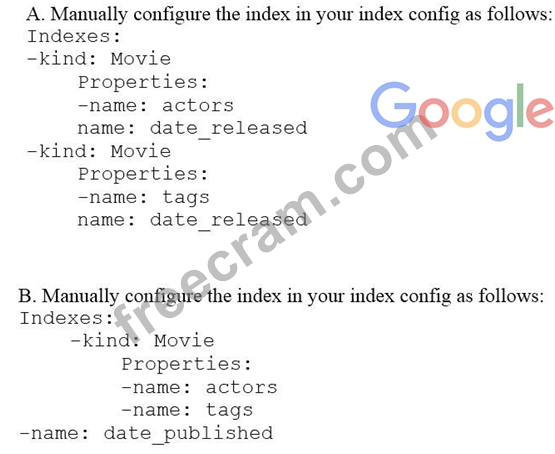

- A. Option D
- B. Option C
- C. Option A
- D. Option B.
Answer: C
NEW QUESTION # 131
You have uploaded 5 years of log data to Cloud Storage A user reported that some data points in the log data are outside of their expected ranges, which indicates errors You need to address this issue and be able to run the process again in the future while keeping the original data for compliance reasons What should you do?
- A. Create a Compute Engine instance and create a new copy of the data in Cloud Storage Skip the rows with errors
- B. Create a Cloud Dataflow workflow that reads the data from Cloud Storage, checks for values outside the expected range, sets the value to an appropriate default, and writes the updated records to a new dataset in Cloud Storage
- C. Import the data from Cloud Storage into BigQuery Create a new BigQuery table, and skip the rows with errors.
- D. Create a Cloud Dataflow workflow that reads the data from Cloud Storage, checks for values outside the expected range, sets the value to an appropriate default, and writes the updated records to the same dataset in Cloud Storage
Answer: B
NEW QUESTION # 132
Your team is working on a binary classification problem. You have trained a support vector machine (SVM) classifier with default parameters, and received an area under the Curve (AUC) of 0.87 on the validation set.
You want to increase the AUC of the model. What should you do?
- A. Deploy the model and measure the real-world AUC; it's always higher because of generalization
- B. Scale predictions you get out of the model (tune a scaling factor as a hyperparameter) in order to get the highest AUC
- C. Perform hyperparameter tuning
- D. Train a classifier with deep neural networks, because neural networks would always beat SVMs
Answer: C
Explanation:
https://towardsdatascience.com/understanding-hyperparameters-and-its-optimisation-techniques-f0debba07568
NEW QUESTION # 133
You are planning to migrate your current on-premises Apache Hadoop deployment to the cloud. You need to ensure that the deployment is as fault-tolerant and cost-effective as possible for long-running batch jobs. You want to use a managed service. What should you do?
- A. Install Hadoop and Spark on a 10-node Compute Engine instance group with preemptible instances. Store data in HDFS. Change references in scripts from hdfs:// to gs://
- B. Deploy a Cloud Dataproc cluster. Use a standard persistent disk and 50% preemptible workers. Store data in Cloud Storage, and change references in scripts from hdfs:// to gs://
- C. Install Hadoop and Spark on a 10-node Compute Engine instance group with standard instances. Install the Cloud Storage connector, and store the data in Cloud Storage. Change references in scripts from hdfs:// to gs://
- D. Deploy a Cloud Dataproc cluster. Use an SSD persistent disk and 50% preemptible workers. Store data in Cloud Storage, and change references in scripts from hdfs:// to gs://
Answer: B
NEW QUESTION # 134
......
Google Professional-Data-Engineer (Google Certified Professional Data Engineer) certification exam is designed to test the skills and knowledge of data professionals who specialize in designing and building data processing systems on Google Cloud Platform. Google Certified Professional Data Engineer Exam certification is ideal for data engineers, developers, architects, and other IT professionals who want to validate their skills and expertise in managing and processing data on Google Cloud Platform.
Verified & Correct Professional-Data-Engineer Practice Test Reliable Source Feb 06, 2026 Updated: https://www.freecram.com/Google-certification/Professional-Data-Engineer-exam-dumps.html
Free Google Professional-Data-Engineer Exam Files Downloaded Instantly: https://drive.google.com/open?id=17KGjgTE4URt9khetEuAGTkfqyJnU3ts8