

[UPDATED 2026] Google Cloud-Digital-Leader Questions Prepare with Free Demo of PDF
NEW 2026 Certification Sample Questions Cloud-Digital-Leader Dumps & Practice Exam
Google Cloud Digital Leader Certification Exam is designed for individuals who aspire to become proficient in the latest technologies for digital transformation. Google Cloud Digital Leader certification is aimed at professionals who wish to demonstrate their knowledge of digital leadership and management in the cloud. Cloud-Digital-Leader exam tests the candidate's skills in the areas of cloud computing, data analysis, machine learning, and artificial intelligence.
NEW QUESTION # 175
You are running a data warehouse on BigQuery. A partner company is offering a recommendation engine based on the data in your data warehouse. The partner company is also running their applica-tion on Google Cloud. They manage the resources in their own project, but they need access to the BigQuery dataset in your project. You want to provide the partner company with access to the da-taset. What should you do?
- A. Ask the partner to create a Service Account in their project, and grant their Service Account access to the BigQuery dataset in your project.
- B. Create a Service Account in your own project, and ask the partner to grant this Service Account access to BigQuery in their project.
- C. Ask the partner to create a Service Account in their project, and have them give the Service Account access to BigQuery in their project.
- D. Create a Service Account in your own project, and grant this Service Account ac-cess to BigQuery in your project.
Answer: A
Explanation:
- if the need is to authenticate the application to access your dataset, it's the application's serice account that will be provided during the authentication, so the service account is to be created at their side to run the application
NEW QUESTION # 176
You are currently managing workloads running on Windows Server for which your company owns the licenses. Your workloads are only needed during working hours, which allows you to shut down the instances during the weekend. Your Windows Server licenses are up for renewal in a month, and you want to optimize your license cost.
What should you do?
- A. Migrate the workloads to Compute Engine with a bring-your-own-license (BYOL) model
- B. Renew your licenses for an additional period of 3 years. Renew your licenses for an additional period of 3 years. Negotiate a cost reduction with your current hosting provider wherein infrastructure cost is reduced when workloads are not in use
- C. Renew your licenses for an additional period of 2 years. Negotiate a cost reduction by committing to an automatic renewal of the licenses at the end of the 2 year period
- D. Migrate the workloads to Compute Engine with a pay-as-you-go (PAYG) model
Answer: D
Explanation:
The PAYG model is more convenient because you only pay for usage. And the case describes that the workloads are only run on certain days.
NEW QUESTION # 177
You are working in a company that provides different services to its customer. Now it also wants to offer some paid API services to its B2B customers for e.g. google provides google maps API, cloud vision API, and language translation API. You need to figure out the best solution for the service.
- A. Frontend & Backend Development with NodeJs and angular etc.
- B. Java Programming Spring Boot Framework for to solve the problem of APIs man-agement.
- C. Apigee API Management
- D. Cloud Functions with Firestore and payment gateways integration development.
Answer: C
Explanation:
A top-level idea about Apigee API Management and its offered features can help you solve all questions related to Apigee in Cloud Digital Leader Practice Exam.
Apigee is a platform for developing and managing APIs. By fronting services with a proxy layer, Apigee provides an abstraction or facade for your backend service APIs and provides security, rate limiting, quotas, analytics, and more.
Apigee services: The APIs that you use to create, manage, and deploy your API proxies.
Apigee runtime: A set of containerized runtime services in a Kubernetes cluster that Google maintains. All API traffic passes through and is processed by these services.
NEW QUESTION # 178
An organization is running Kubernetes applications across multiple cloud environments They want a consistent and centralized management platform Which service should they choose?
- A. Cloud Functions
- B. GKE Enterprise
- C. Compute Engine
- D. Cloud Run
Answer: A
NEW QUESTION # 179
You are currently managing workloads running on Windows Server for which your company owns the licenses. Your workloads are only needed during working hours, which allows you to shut down the instances during the weekend. Your Windows Server licenses are up for renewal in a month, and you want to optimize your license cost.
What should you do?
- A. Renew your licenses for an additional period of 3 years. Renew your licenses for an additional period of 3 years. Negotiate a cost reduction with your current hosting provider wherein infrastructure cost is reduced when workloads are not in use
- B. Renew your licenses for an additional period of 2 years. Negotiate a cost reduction by committing to an automatic renewal of the licenses at the end of the 2 year period
- C. Migrate the workloads to Compute Engine with a pay-as-you-go (PAYG) model
- D. Migrate the workloads to Compute Engine with a bring-your-own-license (BYOL) model
Answer: D
NEW QUESTION # 180
How does Cloud SQL help organizations create business insights?
- A. Integrates with business intelligence and analytics platforms
- B. Transforms business data from unstructured to structured
- C. Generates real-time charts and intelligent analytics
- D. Generates predictions using machine learning models
Answer: A
Explanation:
https://cloud.google.com/sql/docs/postgres/using-query-insights
NEW QUESTION # 181
An organization wants to run their custom application in the cloud in a flexible and scalable way without managing any infrastructure.
Which service model should they use?
- A. Platform as a service
- B. Software as a service
- C. Network as a service
- D. Infrastructure as a service
Answer: A
Explanation:
The correct answer is B. Platform as a service. Here's why:
* Context of the Question: The organization wants to run a custom application in the cloud in a flexible and scalable way without managing any infrastructure.
* Google Cloud Product Relevance:
* Platform as a Service (PaaS) provides a platform that allows customers to develop, run, and manage applications without dealing with the complexity of building and maintaining the underlying infrastructure.
* Google Cloud's App Engine is an example of a PaaS offering. It enables organizations to deploy custom applications in a fully managed environment where scaling, load balancing, and infrastructure management are handled automatically.
* Why Not Other Options:
* A. Infrastructure as a service: IaaS requires the organization to manage the underlying infrastructure (like virtual machines, networks, and storage), which is not suitable if the organization does not want to manage any infrastructure.
* C. Network as a service: NaaS is focused on network connectivity and does not provide the capabilities needed to run custom applications.
* D. Software as a service: SaaS provides pre-built applications managed by a provider; it is not suitable for running custom applications.
Google Cloud Digital Leader References:
* For more on PaaS, refer to the Google App Engine documentation.
NEW QUESTION # 182
An organization needs to migrate specialized workloads to the cloud while maintaining their existing complex licensing and architecture.
What Google Cloud solution should the organization use?
- A. Cloud Functions
- B. Bare Metal Solution
- C. Compute Engine
- D. Cloud Run
Answer: B
Explanation:
"This solution provides a path to modernize your application infrastructure landscape, while maintaining your existing investments and architecture. With Bare Metal Solution, you can bring your specialized workloads to Google Cloud, allowing you access and integration with GCP services with minimal latency."
NEW QUESTION # 183
A customer has new applications to build that has to handle both batch data and streaming dat a. Which product should they choose?
- A. Data Fusion
- B. Dataproc
- C. Dataflow
- D. Dataprep
Answer: C
Explanation:
Dataflow is the managed version of Apache Beam. Beam = Batch + Stream. Unified stream and batch data processing that's serverless, fast, and cost-effective.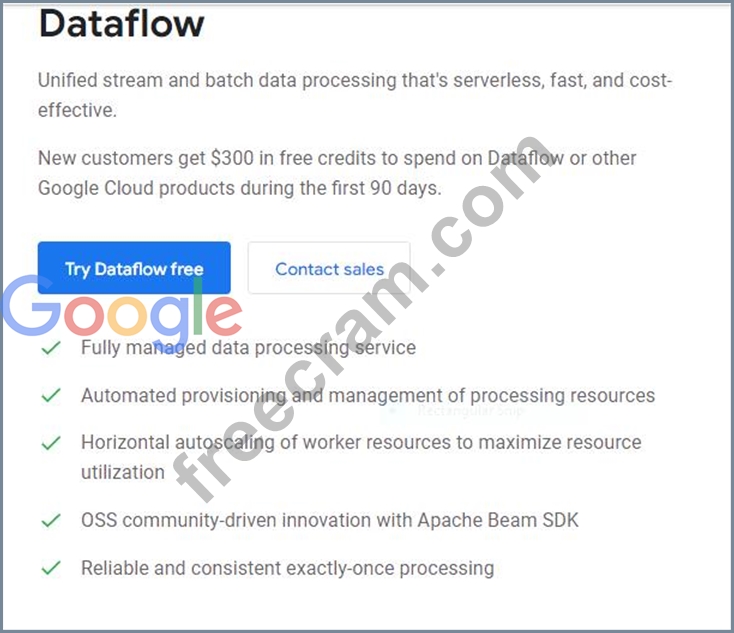
Reference link- https://cloud.google.com/dataflow
NEW QUESTION # 184
An organization wants to move from a tactical cloud adoption approach to a transformational approach.
How should they change their cloud security?
- A. Provide staff identities using only Google Cloud authentication.
- B. Provide multiple layers of network security using a zero-trust model.
- C. Emphasize three main Identity Access Management roles: owner, editor, and viewer.
- D. Emphasize strong perimeter security and trust in their private network.
Answer: B
Explanation:
Explanation
https://www.crowdstrike.com/cybersecurity-101/zero-trust-security/
Zero Trust is a security framework requiring all users, whether in or outside the organization's network, to be authenticated, authorized, and continuously validated for security configuration and posture before being granted or keeping access to applications and data
NEW QUESTION # 185
An organization wants to transform multiple types of structured and unstructured data in the cloud from various sources. The data must be readily accessible for analysis and insights.
Which cloud data storage system should the organization use?
- A. Data warehouse
- B. Private data center
- C. Data field
- D. Relational database
Answer: A
Explanation:
It supports real-time insights. A data warehouse is an enterprise system used for the analysis and reporting of structured and semi-structured data from multiple sources, https://cloud.google.com/learn/what-is-a-data-warehouse
NEW QUESTION # 186
You have experimented with Google Cloud using your own credit card and expensed the costs to your company. Your company wants to streamline the billing process and charge the costs of your projects to their monthly invoice. What should you do?
- A. Set up BigQuery billing export and grant your financial department IAM access to query the data.
- B. Create a ticket with Google Billing Support to ask them to send the invoice to your company.
- C. Grant the financial team the IAM role of Billing Account Usere on the billing ac-count linked to your credit card.
- D. Change the billing account of your projects to the billing account of your company.
Answer: D
Explanation:
Explanation
To change the Cloud Billing account for a project, you need to be able to move a project from one Cloud Billing account to another. To accomplish this task, you need permissions adequate to unlink the project from the existing Cloud Billing account AND to link the project to the target Cloud Billing account. Roles with adequate permissions to perform this task: Project Owner or Project Billing Manager on the project, AND Billing Account Administrator or Billing Account User for the target Cloud Billing account Graphical user interface, text, application, email Description automatically generated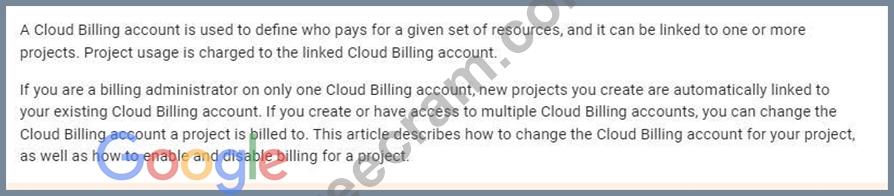
Reference link- https://cloud.google.com/billing/docs/how-to/modify-
NEW QUESTION # 187
Your customer's IT team is in the process of modernizing their customer-facing applications. They've witnessed others getting good results from employing microservices, and they're keen to adopt it themselves.
The first application that they are modernizing has about 5 different sub-parts, which they have identified will be the services. They also identify that each of them has different scale requirements - some services like user login are less frequently used while others like transac-tions are heavily used. What technical strategy would you recommend for them?
- A. Retain the original application in Compute Engine and scale it as needed using Unmanaged Instance Groups.
- B. Retain the original application in Compute Engine and scale it as needed using Managed Instance Groups.
- C. Containerize the services and orchestrate them with Google Kubernetes Engine.
- D. Retain the original application as a backup and also for separately scaling the ser-vices, create new application binaries.
Answer: C
Explanation:
Explanation
Containers and Kubernetes are ideal for the kind of requirement mentioned here - separate microservices that need to scale independently.
Google Kubernetes Engine (GKE) provides a managed environment for deploying, managing, and scaling your containerized applications using Google infrastructure. The GKE environment consists of multiple machines (specifically, Compute Engine instances) grouped together to form a cluster.
Reference link- https://cloud.google.com/kubernetes-engine/docs/concepts/kubernetes-engine-overview
NEW QUESTION # 188
What is the Site Reliability Engineering (SRE) term for an organizations desired level of reliability and performance?
- A. Service-level objective
- B. Service-level indicator
- C. Scalable infrastructure
- D. Enhanced support
Answer: A
NEW QUESTION # 189
A Multiple projects within your organization have long-term VM usage. Based on current demand, they are able to project into the future and estimate how many VM hours they will use every year. Going in for a committed use contract seems sensible. How can you configure committed use easily across all the projects?
- A. Enable committed use with discount sharing for the projects
- B. Take a report of each project's use in the last year. Enable committed use on a per-project basis based on the previous year's numbers.
- C. Share a Google Sheet and request each project team to send in their estimate. Enable committed use accordingly on a per-project basis.
- D. Review the usage of resources by each project on a daily basis. Enable committed use for the following day based on that number, so that it gives maximum granularity without wastage.
Answer: A
Explanation:
Explanation
Enable committed use discounts are applied to the project from which you purchased it. To share the discount across multiple projects linked to your Cloud Billing account, enable committed use discount sharing from the console. When you enable committed use discount sharing, all of your current active committed use dis-counts in all the projects under the same Cloud Billing account, including those you previously purchased and new ones you purchase in the future are shared across your Cloud Billing account. Your sustained use discounts are also pooled and shared across all projects within your Cloud Billing account.
NEW QUESTION # 190
Your large and frequently changing organization's user information is stored in an on-premises LDAP database. The database includes user passwords and group and organization membership.
How should your organization provision Google accounts and groups to access Google Cloud resources?
- A. Use the Identity Platform REST API to create users
- B. Use the Firebase Authentication REST API to create users
- C. Replicate the LDAP infrastructure on Compute Engine
- D. Use Google Cloud Directory Sync to create users
Answer: D
Explanation:
You can run a single instance of Google Cloud Directory Sync to synchronize user accounts and groups to Google Cloud.
Reference: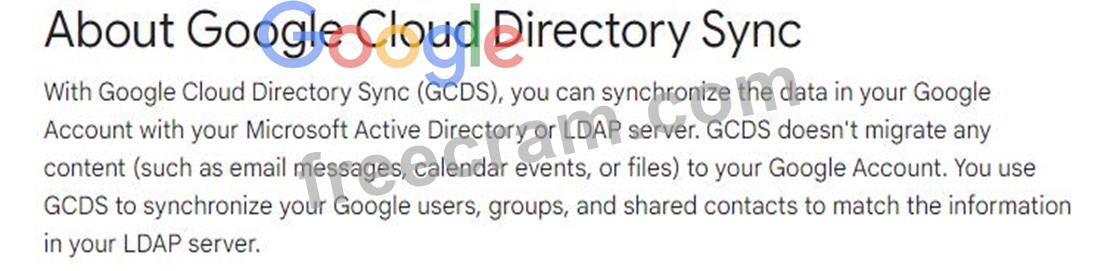
https://support.google.com/a/answer/106368?hl=en
NEW QUESTION # 191
Google Cloud Platform (GCP) provides three main compliance resource webpages. What are they? (Select Three Answer)
- A. Compliance Offerings
- B. Compliance Reports Manager
- C. GDPR Home Page
- D. TechCentral
- E. Support Hub
Answer: A,B,C
Explanation:
Compliance Reports Manager, GDPR Home Page, Compliance Offerings
GCP provides three main compliance resource webpages
Compliance Reports Manager - https://cloud.google.com/security/compliance/compliance-reports-manager Text, timeline Description automatically generated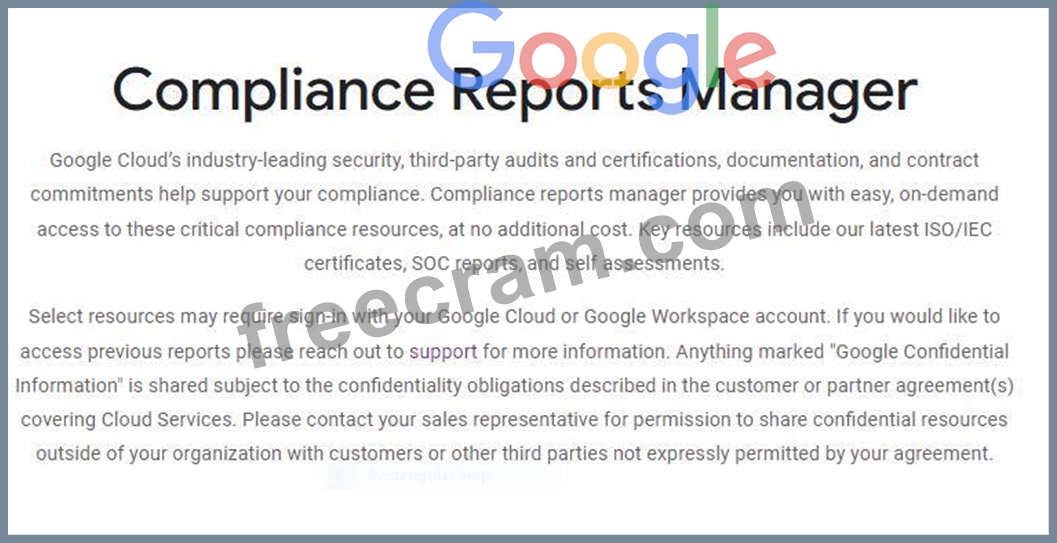
Compliance Offerings - https://cloud.google.com/security/compliance/offerings GDPR Resource Center - https://cloud.google.com/security/gdpr/resource-center At Google Cloud, we champion initiatives that prioritize and improve the security and privacy of customer personal data, and want you, as a Google Cloud customer, to feel confident using our services in light of GDPR requirements. If you partner with Google Cloud, we will support your GDPR compliance efforts
NEW QUESTION # 192
You are migrating workloads to the cloud. The goal of the migration is to serve customers worldwide as quickly as possible According to local regulations, certain data is required to be stored in a specific geographic area, and it can be served worldwide. You need to design the architecture and deployment for your workloads.
What should you do?
- A. Select a private cloud provider that is only active in the required geographic area
- B. Select a private cloud provider that globally replicates data storage for fast data access
- C. Select a public cloud provider that guarantees data location in the required geographic area
- D. Select a public cloud provider that is only active in the required geographic area
Answer: C
Explanation:
The goal of the migration is to serve customers worldwide as quickly as possible According to local regulations, certain data is required to be stored in a specific geographic area, and it can be served worldwide" This characteristic are inherent to the public cloud provider
NEW QUESTION # 193
You are consulting for a client who is migrating to Google Cloud. They presently have a matrix or-ganization.
Their IT environments were managed around projects. Each team had multiple projects. All the projects had a flat structure under the company. What would you advise them when plan-ning for the move?
- A. Since a Project could spawn other sub-Projects, on Google Cloud it is better to as-sign a folder for each Project.
- B. On Google Cloud, create a folder corresponding to each team. Under that, there could be projects or further sub folders as the team decides.
- C. The flat structure is what is currently used in IT organizations, and this can be used as-is which will provide the best results.
- D. In terms of not disturbing the project developers and testers, advise them that the strategic decision is to retain the structure on Google Cloud also.
Answer: B
Explanation:
Explanation
Folders for a related group of projects are the recommended approach.
-> A flat structure under the organization node is possible on Google Cloud, but it is not recommended. It becomes tougher to manage.
-> Projects cannot have sub-projects; there can only be resources within Projects.
Reference link- https://cloud.google.com/resource-manager/docs/cloud-platform-resource-hierarchy
NEW QUESTION # 194
An organization wants to refactor their application by using a microservices architecture when migrating to the cloud. Which benefit would this action provide?
- A. No code changes will be required.
- B. The application will become PCI-DSS compliant by default.
- C. The refactored application is more efficient and scalable.
- D. This migration pattern provides the fastest path to the cloud.
Answer: C
Explanation:
The correct answer is A. The refactored application is more efficient and scalable. Here's why:
Context of the Questio n : The organization wants to refactor its application into a microservices architecture when migrating to the cloud.
Google Cloud Product Relevance:
Microservices architecture breaks down applications into smaller, independent services that can be developed, deployed, and scaled independently. This increases efficiency and scalability, as each microservice can be scaled according to its needs without affecting the entire application.
Google Cloud provides tools such as Kubernetes Engine (GKE) for container orchestration, Anthos for managing microservices across hybrid and multi-cloud environments, and Cloud Run for deploying containerized applications efficiently.
Why Not Other Options:
B . No code changes will be required: Refactoring to microservices often requires significant code changes to decouple services.
C . This migration pattern provides the fastest path to the cloud: Refactoring to microservices is a complex process that typically takes more time compared to a "lift-and-shift" migration.
D . The application will become PCI-DSS compliant by default: Compliance with PCI-DSS (Payment Card Industry Data Security Standard) depends on specific security controls, not on using microservices architecture.
Google Cloud Digital Leader Reference:
For more information on microservices and cloud-native architectures, refer to the Google Cloud Microservices documentation.
NEW QUESTION # 195
......
Cloud-Digital-Leader Deluxe Study Guide with Online Test Engine: https://www.freecram.com/Google-certification/Cloud-Digital-Leader-exam-dumps.html
Cloud-Digital-Leader Test Prep Training Practice Exam Questions Practice Tests: https://drive.google.com/open?id=1N2fnZixb0bODryZM2YIjJizFIHoEVsGS