

2024 Free CompTIA SY0-701 Exam Files Downloaded Instantly
Pass CompTIA SY0-701 exam Dumps 100 Pass Guarantee With Latest Demo
NEW QUESTION # 26
A security operations center determines that the malicious activity detected on a server is normal. Which of the following activities describes the act of ignoring detected activity in the future?
- A. Aggregating
- B. Tuning
- C. Archiving
- D. Quarantining
Answer: B
Explanation:
Explanation
Tuning is the activity of adjusting the configuration or parameters of a security tool or system to optimize its performance and reduce false positives or false negatives. Tuning can help to filter out the normal or benign activity that is detected by the security tool or system, and focus on the malicious or anomalous activity that requires further investigation or response. Tuning can also help to improve the efficiency and effectiveness of the security operations center by reducing the workload and alert fatigue of the analysts. Tuning is different from aggregating, which is the activity of collecting and combining data from multiple sources or sensors to provide a comprehensive view of the security posture. Tuning is also different from quarantining, which is the activity of isolating a potentially infected or compromised device or system from the rest of the network to prevent further damage or spread. Tuning is also different from archiving, which is the activity of storing and preserving historical data or records for future reference or compliance. The act of ignoring detected activity in the future that is deemed normal by the security operations center is an example of tuning, as it involves modifying the settings or rules of the security tool or system to exclude the activity from the detection scope.
Therefore, this is the best answer among the given options. References = Security Alerting and Monitoring Concepts and Tools - CompTIA Security+ SY0-701: 4.3, video at 7:00; CompTIA Security+ SY0-701 Certification Study Guide, page 191.
NEW QUESTION # 27
Which of the following roles, according to the shared responsibility model, is responsible for securing the company's database in an IaaS model for a cloud environment?
- A. Client
- B. DBA
- C. Cloud provider
- D. Third-party vendor
Answer: A
Explanation:
According to the shared responsibility model, the client and the cloud provider have different roles and responsibilities for securing the cloud environment, depending on the service model. In an IaaS (Infrastructure as a Service) model, the cloud provider is responsible for securing the physical infrastructure, such as the servers, storage, and network devices, while the client is responsible for securing the operating systems, applications, and data that run on the cloud infrastructure. Therefore, the client is responsible for securing the company's database in an IaaS model for a cloud environment, as the database is an application that stores data. The client can use various security controls, such as encryption, access control, backup, and auditing, to protect the database from unauthorized access, modification, or loss. The third-party vendor and the DBA (Database Administrator) are not roles defined by the shared responsibility model, but they may be involved in the implementation or management of the database security. References = CompTIA Security+ SY0-701 Certification Study Guide, page 263-264; Professor Messer's CompTIA SY0-701 Security+ Training Course, video 3.1 - Cloud and Virtualization, 5:00 - 7:40.
NEW QUESTION # 28
A technician wants to improve the situational and environmental awareness of existing users as they transition from remote to in-office work. Which of the following is thebestoption?
- A. Modify the content of recurring training.
D Implement a phishing campaign - B. Update the content of new hire documentation.
- C. Send out periodic security reminders.
Answer: A
Explanation:
Recurring training is a type of security awareness training that is conducted periodically to refresh and update the knowledge and skills of the users. Recurring training can help improve the situational and environmental awareness of existing users as they transition from remote to in-office work, as it can cover the latest threats, best practices, and policies that are relevant to their work environment. Modifying the content of recurring training can ensure that the users are aware of the current security landscape and the expectations of their roles. References = CompTIA Security+ Study Guide with over 500 Practice Test Questions: Exam SY0-701,
9th Edition, Chapter 5, page 232. CompTIA Security+ (SY0-701) Certification Exam Objectives, Domain 5.1, page 18.
NEW QUESTION # 29
Select the appropriate attack and remediation from each drop-down list to label the corresponding attack with its remediation.
INSTRUCTIONS
Not all attacks and remediation actions will be used.
If at any time you would like to bring back the initial state of the simulation, please click the Reset All button.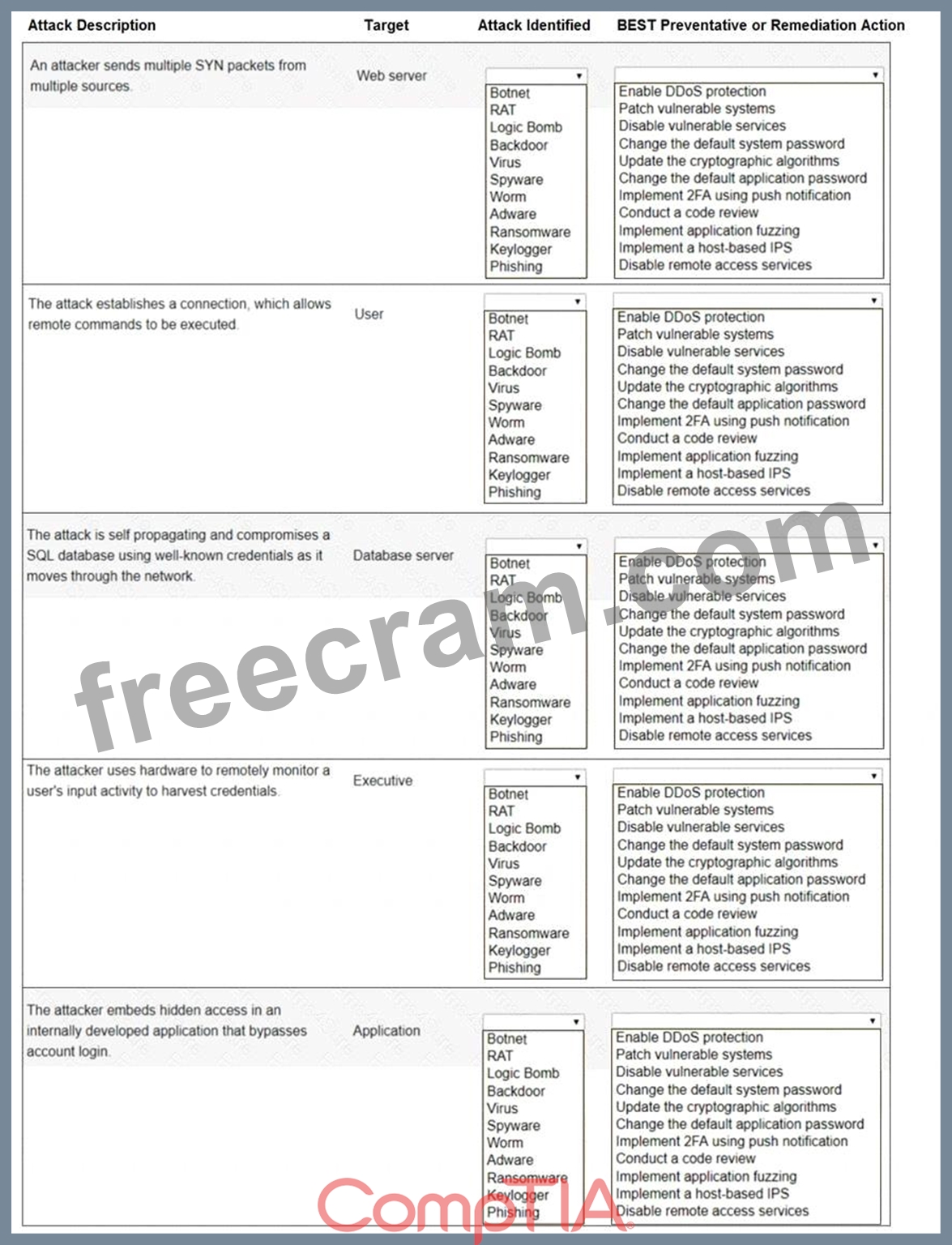
Answer:
Explanation: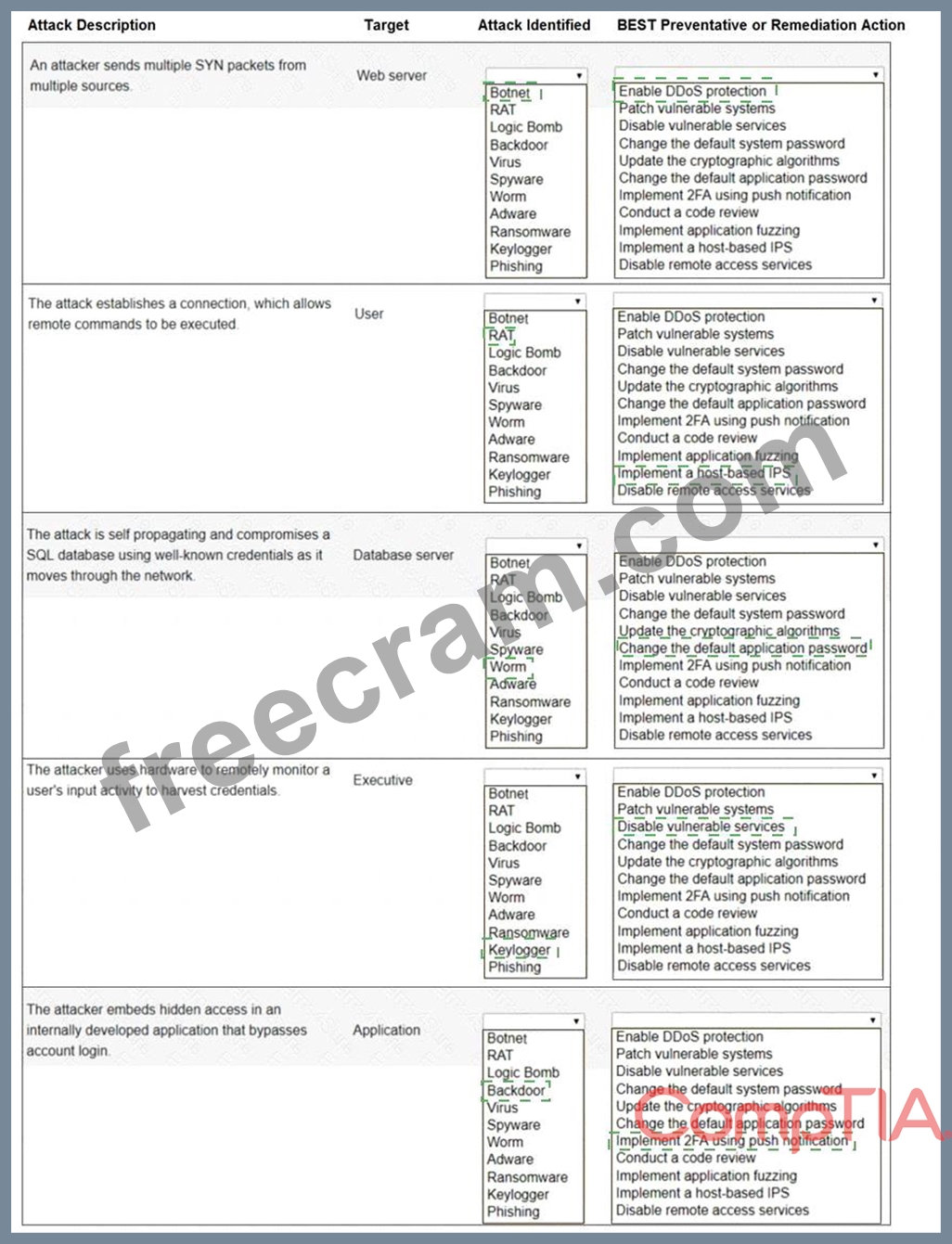
Explanation
Web serverBotnet Enable DDoS protectionUser RAT Implement a host-based IPSDatabase server Worm Change the default application passwordExecutive KeyloggerDisable vulnerable servicesApplication Backdoor Implement 2FA using push notification A screenshot of a computer program Description automatically generated with low confidence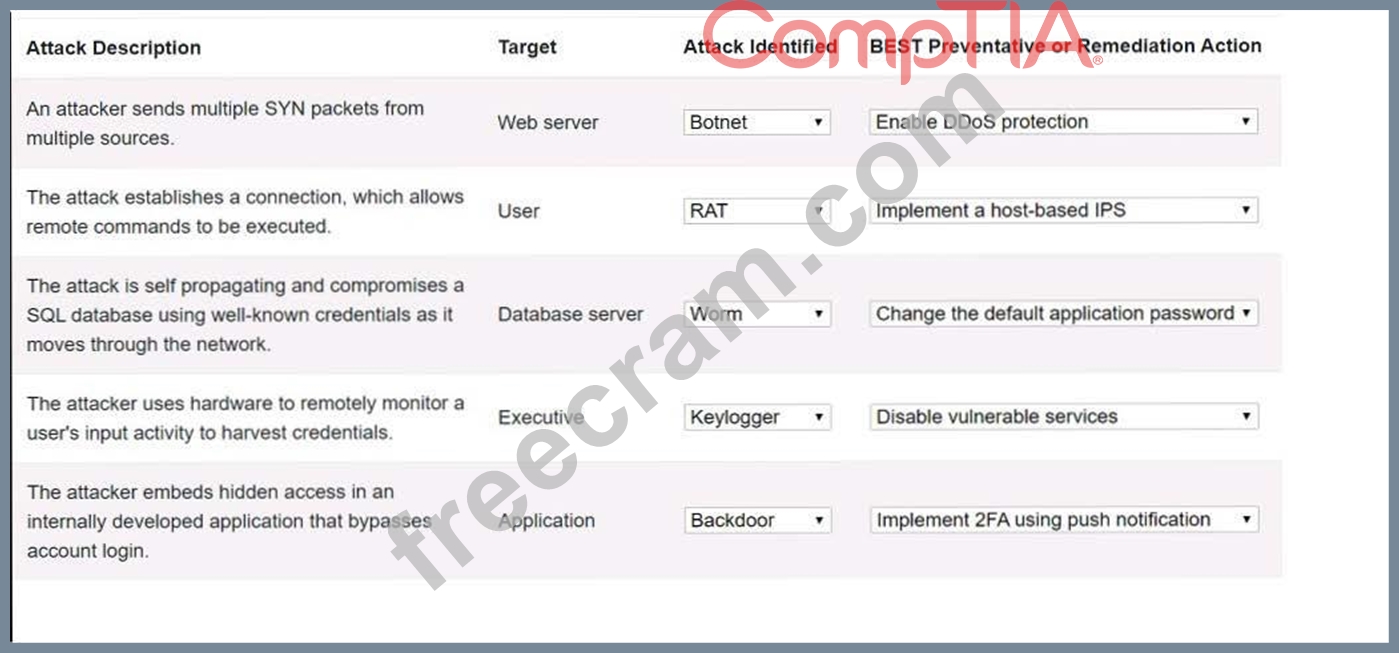
NEW QUESTION # 30
A company decided to reduce the cost of its annual cyber insurance policy by removing the coverage for ransomware attacks.
Which of the following analysis elements did the company most likely use in making this decision?
- A. MTBF
- B. IMTTR
- C. RTO
- D. ARO
Answer: D
Explanation:
Explanation
ARO (Annualized Rate of Occurrence) is an analysis element that measures the frequency or likelihood of an event happening in a given year. ARO is often used in risk assessment and management, as it helps to estimate the potential loss or impact of an event. A company can use ARO to calculate the annualized loss expectancy (ALE) of an event, which is the product of ARO and the single loss expectancy (SLE). ALE represents the expected cost of an event per year, and can be used to compare with the cost of implementing a security control or purchasing an insurance policy.
The company most likely used ARO in making the decision to remove the coverage for ransomware attacks from its cyber insurance policy. The company may have estimated the ARO of ransomware attacks based on historical data, industry trends, or threat intelligence, and found that the ARO was low or negligible. The company may have also calculated the ALE of ransomware attacks, and found that the ALE was lower than the cost of the insurance policy. Therefore, the company decided to reduce the cost of its annual cyber insurance policy by removing the coverage for ransomware attacks, as it deemed the risk to be acceptable or manageable.
IMTTR (Incident Management Team Training and Readiness), RTO (Recovery Time Objective), and MTBF (Mean Time Between Failures) are not analysis elements that the company most likely used in making the decision to remove the coverage for ransomware attacks from its cyber insurance policy. IMTTR is a process of preparing and training the incident management team to respond effectively to security incidents. IMTTR does not measure the frequency or impact of an event, but rather the capability and readiness of the team. RTO is a metric that defines the maximum acceptable time for restoring a system or service after a disruption. RTO does not measure the frequency or impact of an event, but rather the availability and continuity of the system or service. MTBF is a metric that measures the average time between failures of a system or component.
MTBF does not measure the frequency or impact of an event, but rather the reliability and performance of the system or component.
References = CompTIA Security+ SY0-701 Certification Study Guide, page 97-98; Professor Messer's CompTIA SY0-701 Security+ Training Course, video 5.2 - Risk Management, 0:00 - 3:00.
NEW QUESTION # 31
An organization's internet-facing website was compromised when an attacker exploited a buffer overflow.
Which of the following should the organization deploy tobestprotect against similar attacks in the future?
- A. TLS
- B. WAF
- C. NGFW
- D. SD-WAN
Answer: B
Explanation:
A buffer overflow is a type of software vulnerability that occurs when an application writes more data to a memory buffer than it can hold, causing the excess data to overwrite adjacent memory locations. This can lead to unexpected behavior, such as crashes, errors, or code execution. A buffer overflow can be exploited by an attacker to inject malicious code or commands into the application, which can compromise the security and functionality of the system. An organization's internet-facing website was compromised when an attacker exploited a buffer overflow. To best protect against similar attacks in the future, the organization should deploy a web application firewall (WAF). A WAF is a type of firewall that monitors and filters the traffic between a web application and the internet. A WAF can detect and block common web attacks, such as buffer overflows, SQL injections, cross-site scripting (XSS), and more. A WAF can also enforce security policies and rules, such as input validation, output encoding, and encryption. A WAF can provide a layer of protection for the web application, preventing attackers from exploiting its vulnerabilities and compromising its data. References = Buffer Overflows - CompTIA Security+ SY0-701 - 2.3, Web Application Firewalls - CompTIA Security+ SY0-701 - 2.4, [CompTIA Security+ Study Guide with over 500 Practice Test Questions: Exam SY0-701, 9th Edition]
NEW QUESTION # 32
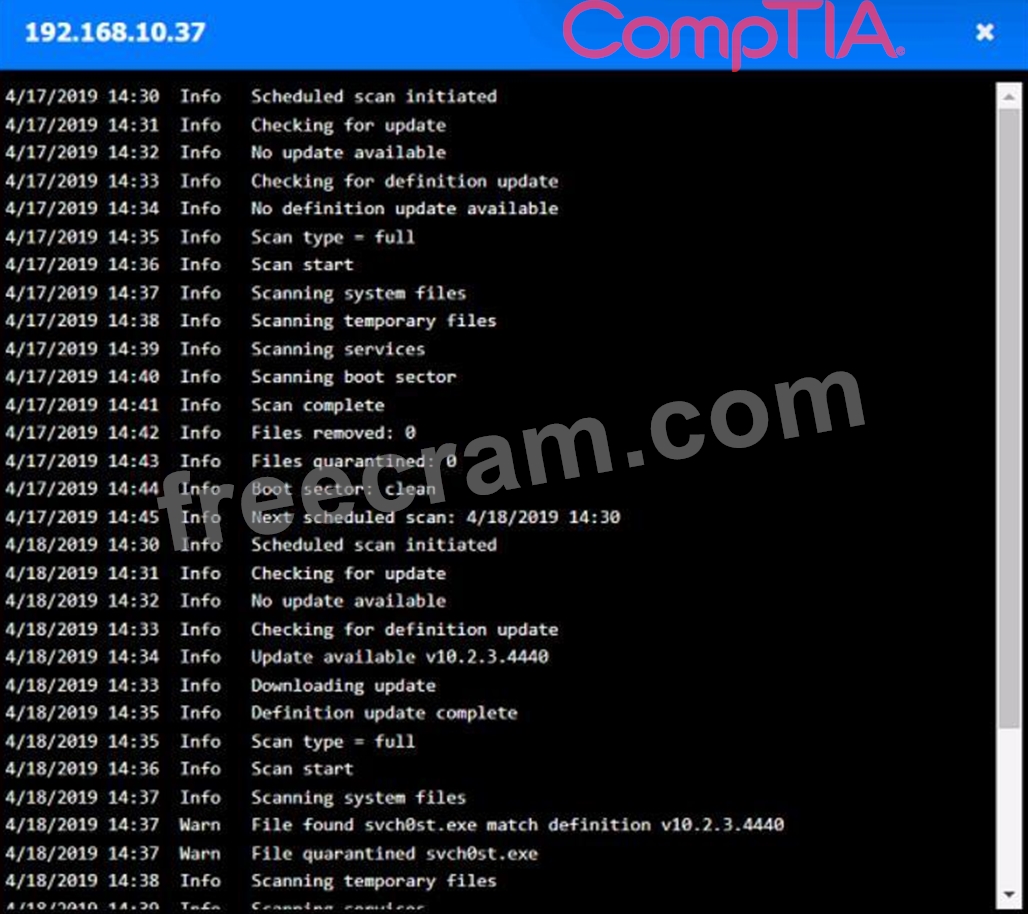
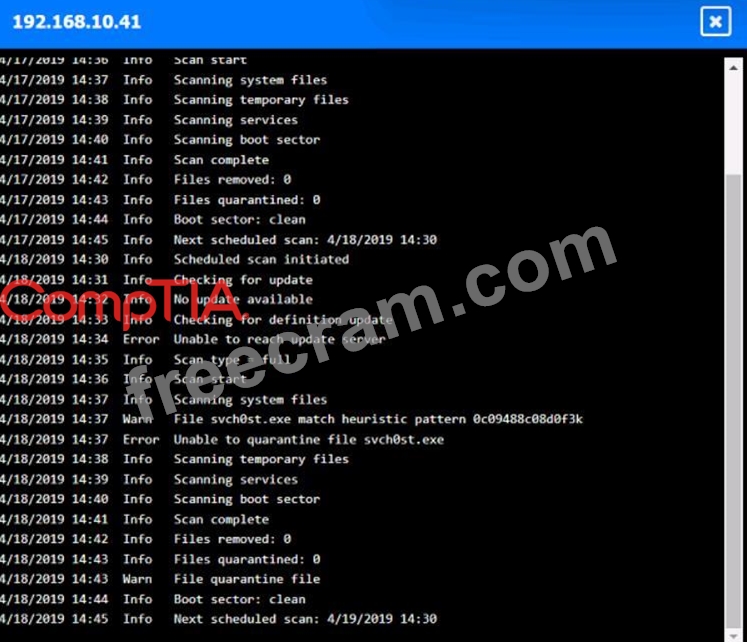
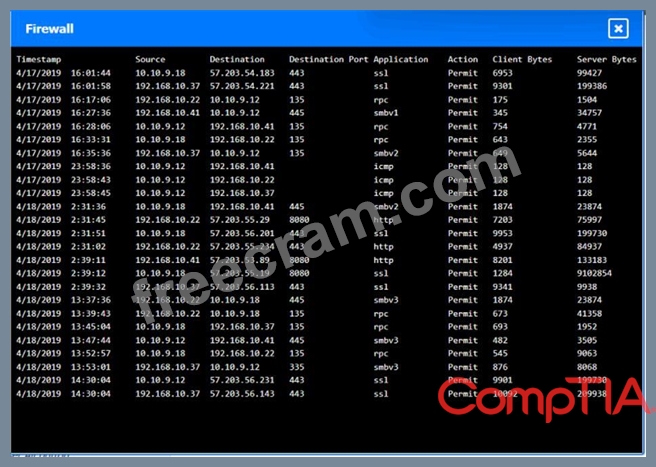
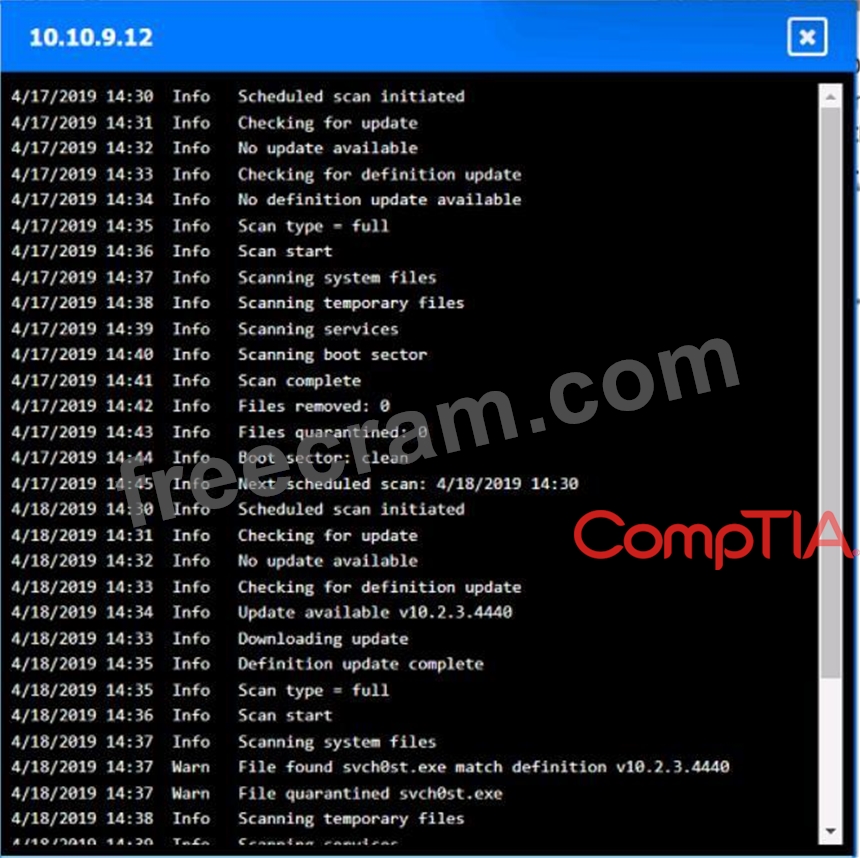
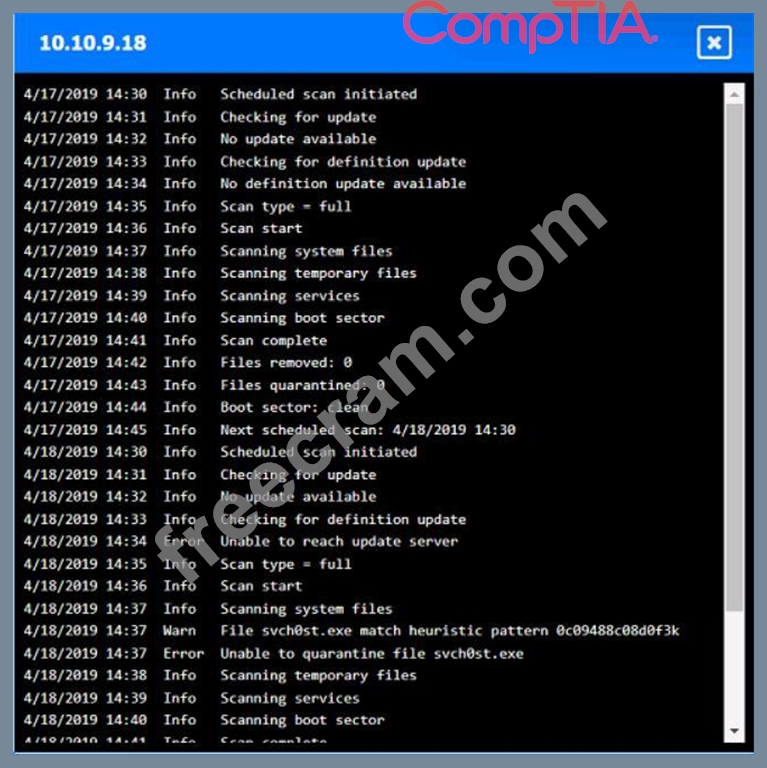
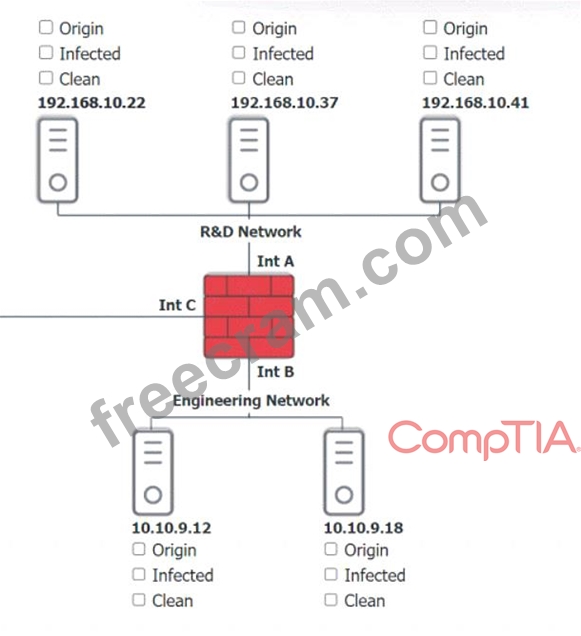
You are security administrator investigating a potential infection on a network.
Click on each host and firewall. Review all logs to determine which host originated the Infecton and then deny each remaining hosts clean or infected.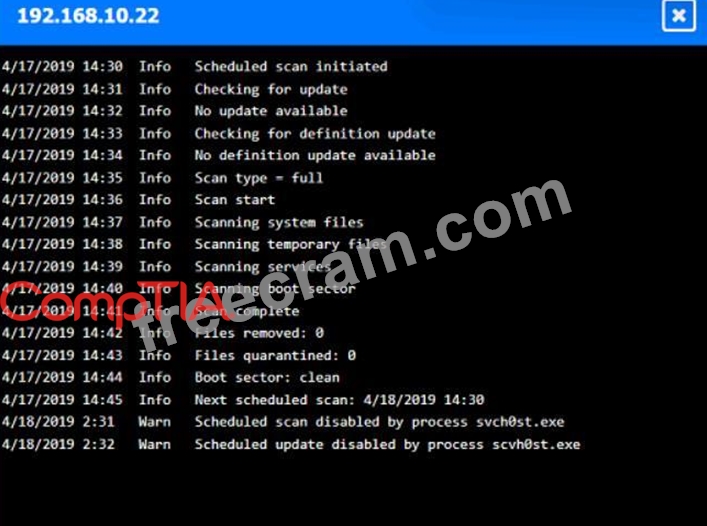
Answer:
Explanation: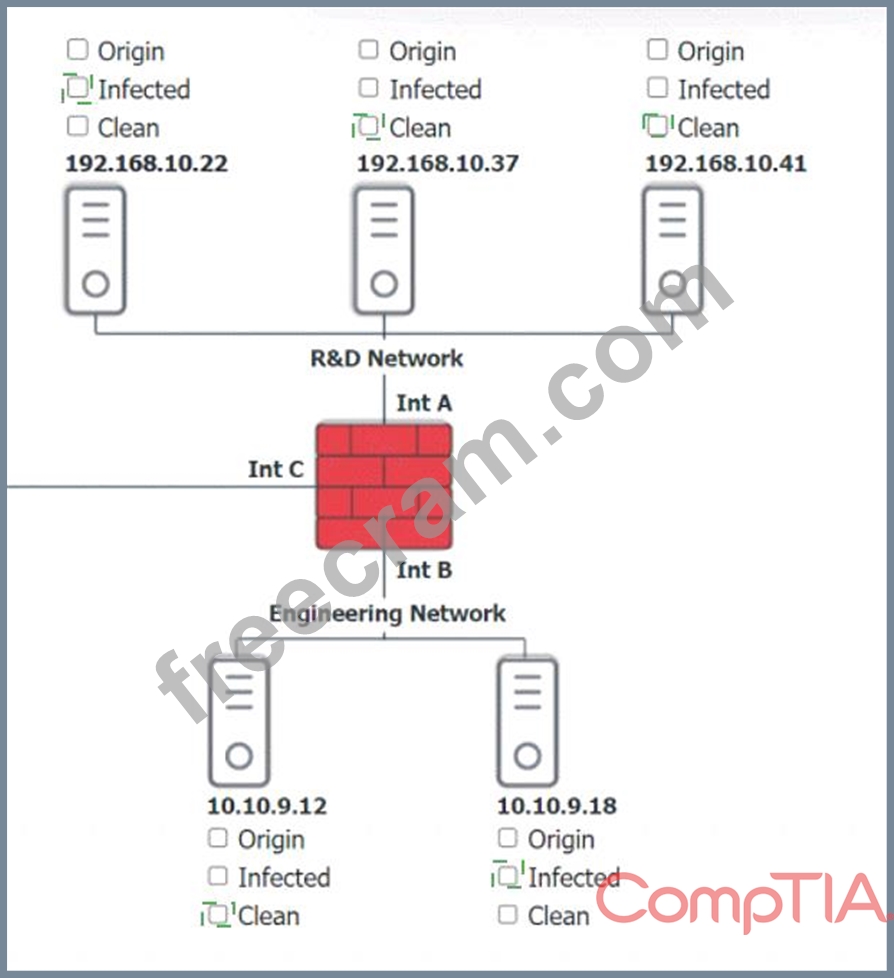
Explanation
Based on the logs, it seems that the host that originated the infection is 192.168.10.22. This host has a suspicious process named svchost.exe running on port 443, which is unusual for a Windows service. It also has a large number of outbound connections to different IP addresses on port 443, indicating that it is part of a botnet.
The firewall log shows that this host has been communicating with 10.10.9.18, which is another infected host on the engineering network. This host also has a suspicious process named svchost.exe running on port 443, and a large number of outbound connections to different IP addresses on port 443.
The other hosts on the R&D network (192.168.10.37 and 192.168.10.41) are clean, as they do not have any suspicious processes or connections.
NEW QUESTION # 33
An employee clicked a link in an email from a payment website that asked the employee to update contact information. The employee entered the log-in information but received a "page not found" error message.
Which of the following types of social engineering attacks occurred?
- A. Typosquatting
- B. Brand impersonation
- C. Phishing
- D. Pretexting
Answer: C
Explanation:
Phishing is a type of social engineering attack that involves sending fraudulent emails that appear to be from legitimate sources, such as payment websites, banks, or other trusted entities. The goal of phishing is to trick the recipients into clicking on malicious links, opening malicious attachments, or providing sensitive information, such as log-in credentials, personal data, or financial details. In this scenario, the employee received an email from a payment website that asked the employee to update contact information. The email contained a link that directed the employee to a fake website that mimicked the appearance of the real one.
The employee entered the log-in information, but received a "page not found" error message. This indicates that the employee fell victim to a phishing attack, and the attacker may have captured the employee's credentials for the payment website. References = Other Social Engineering Attacks - CompTIA Security+ SY0-701 - 2.2, CompTIA Security+: Social Engineering Techniques & Other Attack ... - NICCS, [CompTIA Security+ Study Guide with over 500 Practice Test Questions: Exam SY0-701, 9th Edition]
NEW QUESTION # 34
After a recent ransomware attack on a company's system, an administrator reviewed the log files. Which of the following control types did the administrator use?
- A. Corrective
- B. Detective
- C. Preventive
- D. Compensating
Answer: B
Explanation:
Explanation
Detective controls are security measures that are designed to identify and monitor any malicious activity or anomalies on a system or network. They can help to discover the source, scope, and impact of an attack, and provide evidence for further analysis or investigation. Detective controls include log files, security audits, intrusion detection systems, network monitoring tools, and antivirus software. In this case, the administrator used log files as a detective control to review the ransomware attack on the company's system. Log files are records of events and activities that occur on a system or network, such as user actions, system errors, network traffic, and security alerts. They can provide valuable information for troubleshooting, auditing, and forensics.
References:
Security+ (Plus) Certification | CompTIA IT Certifications, under "About the exam", bullet point 3:
"Operate with an awareness of applicable regulations and policies, including principles of governance, risk, and compliance." CompTIA Security+ Certification Kit: Exam SY0-701, 7th Edition, Chapter 1, page 14: "Detective controls are designed to identify and monitor any malicious activity or anomalies on a system or network." Control Types - CompTIA Security+ SY0-401: 2.1 - Professor Messer IT ..., under "Detective Controls": "Detective controls are security measures that are designed to identify and monitor any malicious activity or anomalies on a system or network."
NEW QUESTION # 35
You are security administrator investigating a potential infection on a network.
Click on each host and firewall. Review all logs to determine which host originated the Infecton and then deny each remaining hosts clean or infected.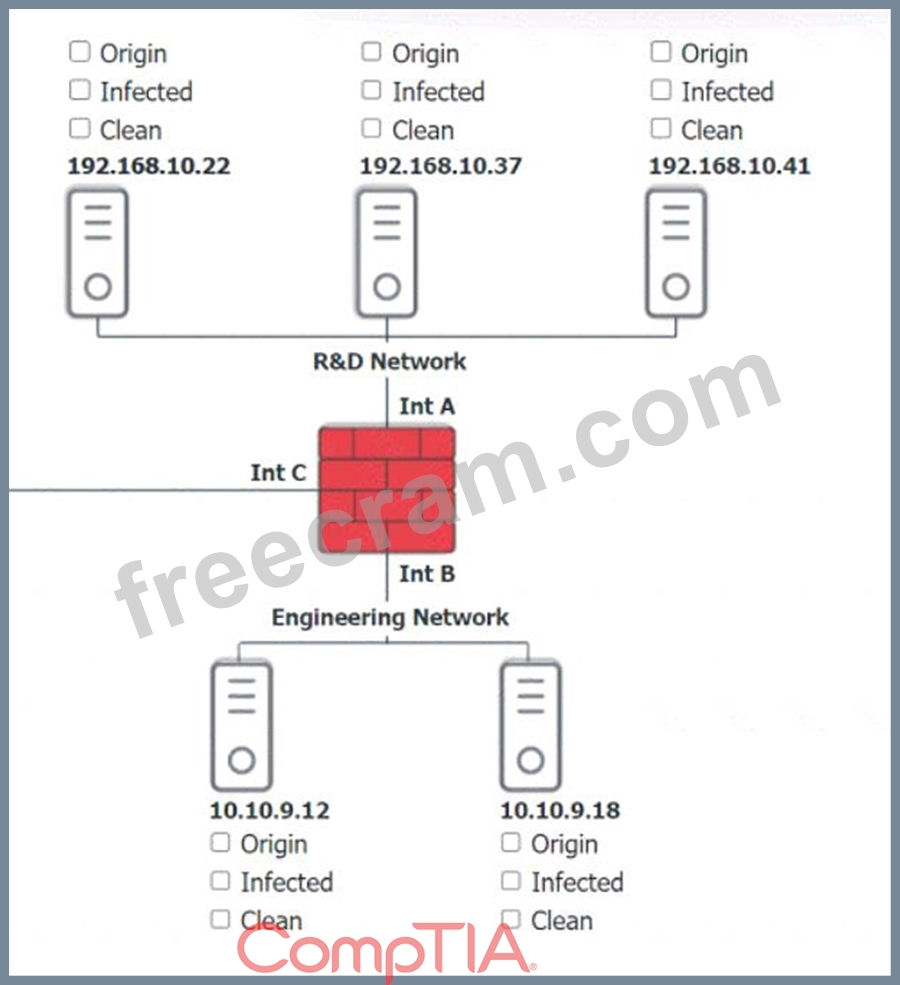
Answer:
Explanation: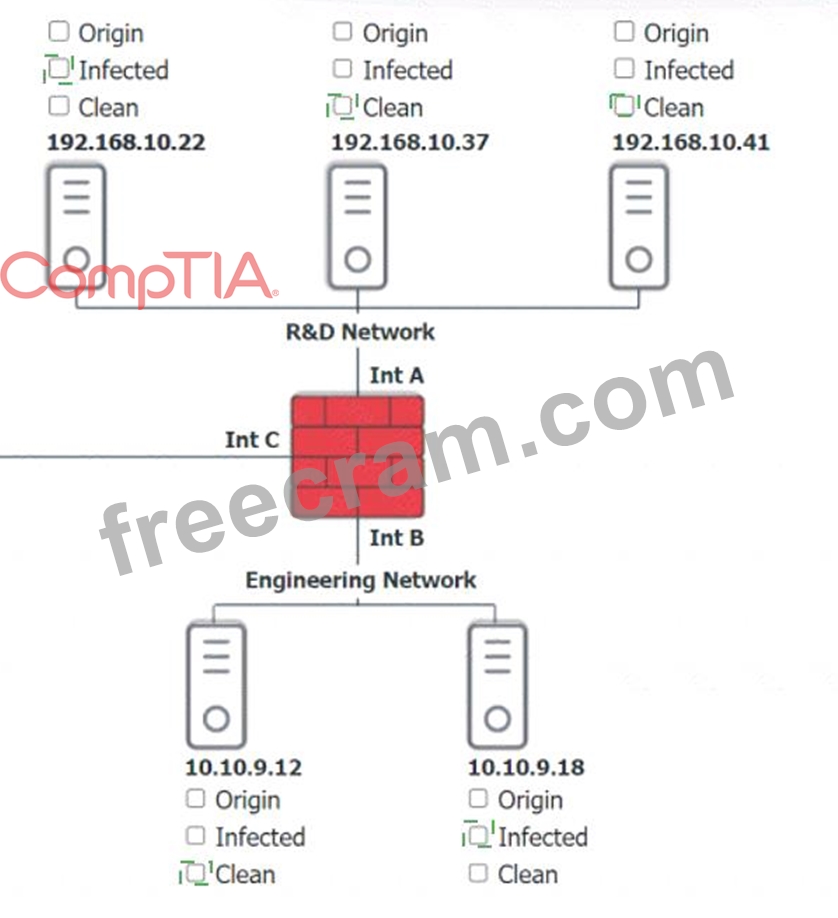
Explanation
Based on the logs, it seems that the host that originated the infection is 192.168.10.22. This host has a suspicious process named svchost.exe running on port 443, which is unusual for a Windows service. It also has a large number of outbound connections to different IP addresses on port 443, indicating that it is part of a botnet.
The firewall log shows that this host has been communicating with 10.10.9.18, which is another infected host on the engineering network. This host also has a suspicious process named svchost.exe running on port 443, and a large number of outbound connections to different IP addresses on port 443.
The other hosts on the R&D network (192.168.10.37 and 192.168.10.41) are clean, as they do not have any suspicious processes or connections.
NEW QUESTION # 36
A company has begun labeling all laptops with asset inventory stickers and associating them with employee IDs. Which of the following security benefits do these actions provide? (Choose two.)
- A. The security team will be able to send user awareness training to the appropriate device.
- B. If a security incident occurs on the device, the correct employee can be notified.
- C. User-based firewall policies can be correctly targeted to the appropriate laptops.
- D. Users can be mapped to their devices when configuring software MFA tokens.
- E. When conducting penetration testing, the security team will be able to target the desired laptops.
- F. Company data can be accounted for when the employee leaves the organization.
Answer: B,F
Explanation:
Explanation
Labeling all laptops with asset inventory stickers and associating them with employee IDs can provide several security benefits for a company. Two of these benefits are:
A: If a security incident occurs on the device, the correct employee can be notified. An asset inventory sticker is a label that contains a unique identifier for a laptop, such as a serial number, a barcode, or a QR code. By associating this identifier with an employee ID, the security team can easily track and locate the owner of the laptop in case of a security incident, such as a malware infection, a data breach, or a theft. This way, the security team can notify the correct employee about the incident, and provide them with the necessary instructions or actions to take, such as changing passwords, scanning for viruses, or reporting the loss. This can help to contain the incident, minimize the damage, and prevent further escalation.
F: Company data can be accounted for when the employee leaves the organization. When an employee leaves the organization, the company needs to ensure that all the company data and assets are returned or deleted from the employee's laptop. By labeling the laptop with an asset inventory sticker and associating it with an employee ID, the company can easily identify and verify the laptop that belongs to the departing employee, and perform the appropriate data backup, wipe, or transfer procedures. This can help to protect the company data from unauthorized access, disclosure, or misuse by the former employee or any other party.
The other options are not correct because they are not related to the security benefits of labeling laptops with asset inventory stickers and associating them with employee IDs. B. The security team will be able to send user awareness training to the appropriate device. User awareness training is a type of security education that aims to improve the knowledge and behavior of users regarding security threats and best practices. The security team can send user awareness training to the appropriate device by using the email address, username, or IP address of the device, not the asset inventory sticker or the employee ID. C. Users can be mapped to their devices when configuring software MFA tokens. Software MFA tokens are a type of multi-factor authentication that uses a software application to generate a one-time password or a push notification for verifying the identity of a user. Users can be mapped to their devices when configuring software MFA tokens by using the device ID, phone number, or email address of the device, not the asset inventory sticker or the employee ID. D. User-based firewall policies can be correctly targeted to the appropriate laptops. User-based firewall policies are a type of firewall rules that apply to specific users or groups of users, regardless of the device or location they use to access the network. User-based firewall policies can be correctly targeted to the appropriate laptops by using the username, domain, or certificate of the user, not the asset inventory sticker or the employee ID. E. When conducting penetration testing, the security team will be able to target the desired laptops. Penetration testing is a type of security assessment that simulates a real-world attack on a network or system to identify and exploit vulnerabilities. When conducting penetration testing, the security team will be able to target the desired laptops by using the IP address, hostname, or MAC address of the laptop, not the asset inventory sticker or the employee ID. References = CompTIA Security+ Study Guide (SY0-701), Chapter 1: General Security Concepts, page 17. Professor Messer's CompTIA SY0-701 Security+ Training Course, Section 1.4: Asset Management, video: Asset Inventory (6:12).
NEW QUESTION # 37
A security consultant needs secure, remote access to a client environment. Which of the following should the security consultant most likely use to gain access?
- A. EAP
- B. DHCP
- C. NAT
- D. IPSec
Answer: D
Explanation:
IPSec is a protocol suite that provides secure communication over IP networks. IPSec can be used to create virtual private networks (VPNs) that encrypt and authenticate the data exchanged between two or more parties.
IPSec can also provide data integrity, confidentiality, replay protection, and access control. A security consultant can use IPSec to gain secure, remote access to a client environment by establishing a VPN tunnel with the client's network. References: CompTIA Security+ Study Guide: Exam SY0-701, 9th Edition, Chapter
8: Secure Protocols and Services, page 385 1
NEW QUESTION # 38
Which of the following threat actors is themostlikely to use large financial resources to attack critical systems located in other countries?
- A. Unskilled attacker
- B. Nation-state
- C. Insider
- D. Hacktivist
Answer: B
Explanation:
A nation-state is a threat actor that is sponsored by a government or a political entity to conduct cyberattacks against other countries or organizations. Nation-states have large financial resources, advanced technical skills, and strategic objectives that may target critical systems such as military, energy, or infrastructure. Nation-states are often motivated by espionage, sabotage, or warfare12. References = 1:
CompTIA Security+ SY0-701 Certification Study Guide, page 542: Threat Actors - CompTIA Security+ SY0-701 - 2.1, video by Professor Messer.
NEW QUESTION # 39
An organization disabled unneeded services and placed a firewall in front of a business-critical legacy system.
Which of the following best describes the actions taken by the organization?
- A. Risk transfer
- B. Segmentation
- C. Exception
- D. Compensating controls
Answer: D
Explanation:
Compensating controls are alternative security measures that are implemented when the primary controls are not feasible, cost-effective, or sufficient to mitigate the risk. In this case, the organization used compensating controls to protect the legacy system from potential attacks bydisabling unneeded services and placing a firewall in front of it. This reduced the attack surface and the likelihood of exploitation.
References:
Official CompTIA Security+ Study Guide (SY0-701), page 29
Security Controls - CompTIA Security+ SY0-701 - 1.1 1
NEW QUESTION # 40
A company's legal department drafted sensitive documents in a SaaS application and wants to ensure the documents cannot be accessed by individuals in high-risk countries. Which of the following is the most effective way to limit this access?
- A. Encryption
- B. Geolocation policy
- C. Data masking
- D. Data sovereignty regulation
Answer: B
Explanation:
Explanation
A geolocation policy is a policy that restricts or allows access to data or resources based on the geographic location of the user or device. A geolocation policy can be implemented using various methods, such as IP address filtering, GPS tracking, or geofencing. A geolocation policy can help the company's legal department to prevent unauthorized access to sensitive documents from individuals in high-risk countries12.
The other options are not effective ways to limit access based on location:
Data masking: This is a technique of obscuring or replacing sensitive data with fictitious or anonymized data. Data masking can protect the privacy and confidentiality of data, but it does not prevent access to data based on location3.
Encryption: This is a process of transforming data into an unreadable format using a secret key or algorithm. Encryption can protect the integrity and confidentiality of data, but it does not prevent access to data based on location. Encryption can also be bypassed by attackers who have the decryption key or method4.
Data sovereignty regulation: This is a set of laws or rules that govern the storage, processing, and transfer of data within a specific jurisdiction or country. Data sovereignty regulation can affect the availability and compliance of data, but it does not prevent access to data based on location. Data sovereignty regulation can also vary depending on the country or region.
References = 1: CompTIA Security+ SY0-701 Certification Study Guide, page 972: Account Policies - SY0-601 CompTIA Security+ : 3.7, video by Professor Messer3: CompTIA Security+ SY0-701 Certification Study Guide, page 1004: CompTIA Security+ SY0-701 Certification Study Guide, page 101. : CompTIA Security+ SY0-701 Certification Study Guide, page 102.
NEW QUESTION # 41
Which of the following provides the details about the terms of a test with a third-party penetration tester?
- A. Right to audit clause
- B. Supply chain analysis
- C. Rules of engagement
- D. Due diligence
Answer: C
Explanation:
Explanation
Rules of engagement are the detailed guidelines and constraints regarding the execution of information security testing, such as penetration testing. They define the scope, objectives, methods, and boundaries of the test, as well as the roles and responsibilities of the testers and the clients. Rules of engagement help to ensure thatthe test is conducted in a legal, ethical, and professional manner, and that the results are accurate and reliable. Rules of engagement typically include the following elements:
* The type and scope of the test, such as black box, white box, or gray box, and the target systems, networks, applications, or data.
* The client contact details and the communication channels for reporting issues, incidents, or emergencies during the test.
* The testing team credentials and the authorized tools and techniques that they can use.
* The sensitive data handling and encryption requirements, such as how to store, transmit, or dispose of any data obtained during the test.
* The status meeting and report schedules, formats, and recipients, as well as the confidentiality and non-disclosure agreements for the test results.
* The timeline and duration of the test, and the hours of operation and testing windows.
* The professional and ethical behavior expectations for the testers, such as avoiding unnecessary damage, disruption, or disclosure of information.
Supply chain analysis, right to audit clause, and due diligence are not related to the terms of a test with a third-party penetration tester. Supply chain analysis is the process of evaluating the security and risk posture of the suppliers and partners in a business network. Right to audit clause is a provision in a contract that gives one party the right to audit another party to verify their compliance with the contract terms and conditions.
Due diligence is the process of identifying and addressing the cyber risks that a potential vendor or partner brings to an organization.
References =https://www.yeahhub.com/every-penetration-tester-you-should-know-about-this-rules-of-engageme
https://bing.com/search?q=rules+of+engagement+penetration+testing
NEW QUESTION # 42
A company prevented direct access from the database administrators' workstations to the network segment that contains database servers. Which of the following should a database administrator use to access the database servers?
- A. Jump server
- B. Load balancer
- C. RADIUS
- D. HSM
Answer: A
Explanation:
Explanation
A jump server is a device or virtual machine that acts as an intermediary between a user's workstation and a remote network segment. A jump server can be used to securely access servers or devices that are not directly reachable from the user's workstation, such as database servers. A jump server can also provide audit logs and access control for the remote connections. A jump server is also known as a jump box or a jump host12.
RADIUS is a protocol for authentication, authorization, and accounting of network access. RADIUS is not a device or a method to access remote servers, but rather a way to verify the identity and permissions of users or devices that request network access34.
HSM is an acronym for Hardware Security Module, which is a physical device that provides secure storage and generation of cryptographic keys. HSMs are used to protect sensitive data and applications, such as digital signatures, encryption, and authentication. HSMs are not used to access remote servers, but rather to enhance the security of the data and applications that reside on them5 .
A load balancer is a device or software that distributes network traffic across multiple servers or devices, based on criteria such as availability, performance, or capacity. A load balancer can improve the scalability, reliability, and efficiency of network services, such as web servers, application servers, or database servers. A load balancer is not used to access remote servers, but rather to optimize the delivery of the services that run on them . References = How to access a remote server using a jump host Jump server RADIUS Remote Authentication Dial-In User Service (RADIUS) Hardware Security Module (HSM)
[What is an HSM?]
[Load balancing (computing)]
[What is Load Balancing?]
NEW QUESTION # 43
Which of the following would be best suited for constantly changing environments?
- A. Containers
- B. RTOS
- C. SCADA
- D. Embedded systems
Answer: A
Explanation:
Explanation
Containers are a method of virtualization that allows applications to run in isolated environments with their own dependencies, libraries, and configurations. Containers are best suited for constantly changing environments because they are lightweight, portable, scalable, and easy to deploy and update. Containers can also support microservices architectures, which enable faster and more frequent delivery of software features. References: CompTIA Security+ Study Guide: Exam SY0-701, 9th Edition, Chapter 10: Mobile Device Security, page 512 1
NEW QUESTION # 44
Which of the following must be considered when designing a high-availability network? (Choose two).
- A. Ability to patch
- B. Extensible authentication
- C. Physical isolation
- D. Attack surface
- E. Responsiveness
- F. Ease of recovery
Answer: D,F
Explanation:
Explanation
A high-availability network is a network that is designed to minimize downtime and ensure continuous operation even in the event of a failure or disruption. A high-availability network must consider the following factors12:
* Ease of recovery: This refers to the ability of the network to restore normal functionality quickly and efficiently after a failure or disruption. Ease of recovery can be achieved by implementing backup and restore procedures, redundancy and failover mechanisms, fault tolerance and resilience, and disaster recovery plans.
* Attack surface: This refers to the amount of exposure and vulnerability of the network to potential threats and attacks. Attack surface can be reduced by implementing security controls such as firewalls, encryption, authentication, access control, segmentation, and hardening.
The other options are not directly related to high-availability network design:
* Ability to patch: This refers to the process of updating and fixing software components to address security issues, bugs, or performance improvements. Ability to patch is important for maintaining the security and functionality of the network, but it is not a specific factor for high-availability network design.
* Physical isolation: This refers to the separation of network components or devices from other networks or physical environments. Physical isolation can enhance the security and performance of the network,
* but it can also reduce the availability and accessibility of the network resources.
* Responsiveness: This refers to the speed and quality of the network's performance and service delivery.
Responsiveness can be measured by metrics such as latency, throughput, jitter, and packet loss.
Responsiveness is important for ensuring customer satisfaction and user experience, but it is not a specific factor for high-availability network design.
* Extensible authentication: This refers to the ability of the network to support multiple and flexible authentication methods and protocols. Extensible authentication can improve the security and convenience of the network, but it is not a specific factor for high-availability network design.
References = 1: CompTIA Security+ SY0-701 Certification Study Guide, page 972: High Availability - CompTIA Security+ SY0-701 - 3.4, video by Professor Messer.
NEW QUESTION # 45
A security practitioner completes a vulnerability assessment on a company's network and finds several vulnerabilities, which the operations team remediates. Which of the following should be done next?
- A. Submit a report.
- B. Initiate a penetration test.
- C. Rescan the network.
- D. Conduct an audit.
Answer: C
Explanation:
Explanation
After completing a vulnerability assessment and remediating the identified vulnerabilities, the next step is to rescan the network to verify that the vulnerabilities have been successfully fixed and no new vulnerabilities have been introduced. A vulnerability assessment is a process of identifying and evaluating the weaknesses and exposures in a network, system, or application that could be exploited by attackers. A vulnerability assessment typically involves using automated tools, such as scanners, to scan the network and generate a report of the findings. The report may include information such as the severity, impact, and remediation of the vulnerabilities. The operations team is responsible for applying the appropriate patches, updates, or configurations to address the vulnerabilities and reduce the risk to the network. A rescan is necessary to confirm that the remediation actions have been effective and that the network is secure.
Conducting an audit, initiating a penetration test, or submitting a report are not the next steps after completing a vulnerability assessment and remediating the vulnerabilities. An audit is a process of reviewing and verifying the compliance of the network with the established policies, standards, and regulations. An audit may be performed by internal or external auditors, and it may use the results of the vulnerability assessment as part of the evidence. However, an audit is not a mandatory step after a vulnerability assessment, and it does not validate the effectiveness of the remediation actions.
A penetration test is a process of simulating a real-world attack on the network to test the security defenses and identify any gaps or weaknesses. A penetration test may use the results of the vulnerability assessment as a starting point, but it goes beyond scanning and involves exploiting the vulnerabilities to gain access or cause damage. A penetration test may be performed after a vulnerability assessment, but only with the proper authorization, scope, and rules of engagement. A penetration test is not a substitute for a rescan, as it does not verify that the vulnerabilities have been fixed.
Submitting a report is a step that is done after the vulnerability assessment, but before the remediation. The report is a document that summarizes the findings and recommendations of the vulnerability assessment, and it is used to communicate the results to the stakeholders and the operations team. The report may also include a follow-up plan and a timeline for the remediation actions. However, submitting a report is not the final step after the remediation, as it does not confirm that the network is secure.
References = CompTIA Security+ SY0-701 Certification Study Guide, page 372-375; Professor Messer's CompTIA SY0-701 Security+ Training Course, video 4.1 - Vulnerability Scanning, 0:00 - 8:00.
NEW QUESTION # 46
Malware spread across a company's network after an employee visited a compromised industry blog. Which of the following best describes this type of attack?
- A. Smishing
- B. Watering-hole
- C. Disinformation
- D. Impersonation
Answer: B
Explanation:
Explanation
A watering-hole attack is a type of cyberattack that targets groups of users by infecting websites that they commonly visit. The attackers exploit vulnerabilities to deliver a malicious payload to the organization's network. The attack aims to infect users' computers and gain access to a connected corporate network. The attackers target websites known to be popular among members of a particular organization or demographic. The attack differs from phishing and spear-phishing attacks, which typically attempt to steal data or install malware onto users' devices1 In this scenario, the compromised industry blog is the watering hole that the attackers used to spread malware across the company's network. The attackers likely chose this blog because they knew that the employees of the company were interested in its content and visited it frequently. The attackers may have injected malicious code into the blog or redirected the visitors to a spoofed website that hosted the malware. The malware then infected the employees' computers and propagated to the network.
References1: Watering Hole Attacks: Stages, Examples, Risk Factors & Defense ...
NEW QUESTION # 47
A security team is reviewing the findings in a report that was delivered after a third party performed a penetration test. One of the findings indicated that a web application form field is vulnerable to cross-site scripting. Which of the following application security techniques should the security analyst recommend the developer implement to prevent this vulnerability?
- A. Secure cookies
- B. Code signing
- C. Input validation
- D. Version control
Answer: C
Explanation:
Input validation is a technique that checks the user input for any malicious or unexpected data before processing it by the web application. Input validation can prevent cross-site scripting (XSS) attacks, which exploit the vulnerability of a web application to execute malicious scripts in the browser of a victim. XSS attacks can compromise the confidentiality, integrity, and availability of the web application and its users.
Input validation can be implemented on both the client-side and the server-side, but server-side validation is more reliable and secure. Input validation can use various methods, such as whitelisting, blacklisting, filtering, escaping, encoding, and sanitizing the input data. References = CompTIA Security+ Study Guide withover
500 Practice Test Questions: Exam SY0-701, 9th Edition, Chapter 2, page 70. CompTIA Security+ (SY0-701) Certification Exam Objectives, Domain 3.2, page 11. Application Security - SY0-601 CompTIA Security+ :
3.2
NEW QUESTION # 48
An enterprise has been experiencing attacks focused on exploiting vulnerabilities in older browser versions with well-known exploits. Which of the following security solutions should be configured to best provide the ability to monitor and block these known signature-based attacks?
- A. IDS
- B. IPS
- C. DLP
- D. ACL
Answer: B
Explanation:
An intrusion prevention system (IPS) is a security device that monitors network traffic and blocks or modifies malicious packets based on predefined rules or signatures. An IPS can prevent attacks that exploit known vulnerabilities in older browser versions by detecting and dropping the malicious packets before they reach the target system. An IPS can also perform other functions, such as rate limiting, encryption, or redirection. References: CompTIA Security+ Study Guide: Exam SY0-701, 9th Edition, Chapter 3: Securing Networks, page 132.
NEW QUESTION # 49
Which of the following has been implemented when a host-based firewall on a legacy Linux system allows connections from only specific internal IP addresses?
- A. Compensating control
- B. Network segmentation
- C. Transfer of risk
- D. SNMP traps
Answer: A
Explanation:
A compensating control is a security measure that is implemented to mitigate the risk of a vulnerability or a weakness that cannot be resolved by the primary control. A compensating control does not prevent or eliminate the vulnerability or weakness, but it can reduce the likelihood or impact of an attack. A host-based firewall on a legacy Linux system that allows connections from only specific internal IP addresses is an example of a compensating control, as it can limit the exposure of the system to potential threats from external or unauthorized sources. A host-based firewall is a software application that monitors and filters the incoming and outgoing network traffic on a single host, based on a set of rules or policies. A legacy Linux system is an older version of the Linux operating system that may not be compatible with the latest security updates or patches, and may have known vulnerabilities or weaknesses that could be exploited by attackers. References = Security Controls - SY0-601 CompTIA Security+ : 5.1, Security Controls - CompTIA Security+ SY0-501 - 5.7, CompTIA Security+ Study Guide with over 500 Practice Test Questions: Exam SY0-701, 9th Edition, Chapter 5, page 240. CompTIA Security+ (SY0-701) Certification Exam Objectives, Domain 5.1, page 18.
NEW QUESTION # 50
Which of the following vulnerabilities is exploited when an attacker overwrites a register with a malicious address?
- A. VM escape
- B. Buffer overflow
- C. SQL injection
- D. Race condition
Answer: B
NEW QUESTION # 51
......
Read Online SY0-701 Test Practice Test Questions Exam Dumps: https://www.freecram.com/CompTIA-certification/SY0-701-exam-dumps.html
The SY0-701 PDF Dumps Greatest for the CompTIA Exam Study Guide!: https://drive.google.com/open?id=1zPhpntHBKfnVi6IsxUIjTbzwuMnDvfci