

AI-900 Exam Dumps Free Test Engine Verified By Microsoft Certified: Azure AI Fundamentals Certified Experts
Use Real Microsoft Achieve the AI-900 Dumps - 100% Exam Passing Guarantee
Microsoft AI-900 exam, also known as the Microsoft Azure AI Fundamentals certification exam, is a great way to demonstrate your proficiency in artificial intelligence (AI) and its applications in the cloud. AI-900 exam is designed for individuals who are interested in pursuing a career in AI or want to showcase their knowledge in this field. AI-900 exam covers a wide range of topics related to AI, machine learning, and natural language processing.
NEW QUESTION # 29
You build a machine learning model by using the automated machine learning user interface (UI).
You need to ensure that the model meets the Microsoft transparency principle for responsible AI.
What should you do?
- A. Set Validation type to Auto.
- B. Enable Explain best model.
- C. Set Max concurrent iterations to 0.
- D. Set Primary metric to accuracy.
Answer: B
Explanation:
Model Explain Ability.
Most businesses run on trust and being able to open the ML "black box" helps build transparency and trust. In heavily regulated industries like healthcare and banking, it is critical to comply with regulations and best practices. One key aspect of this is understanding the relationship between input variables (features) and model output. Knowing both the magnitude and direction of the impact each feature (feature importance) has on the predicted value helps better understand and explain the model. With model explain ability, we enable you to understand feature importance as part of automated ML runs.
Reference:
https://azure.microsoft.com/en-us/blog/new-automated-machine-learning-capabilities-in-azure-machine-learning
NEW QUESTION # 30
For each of the following statements, select Yes if the statement is true. Otherwise, select No.
NOTE: Each correct selection is worth one point.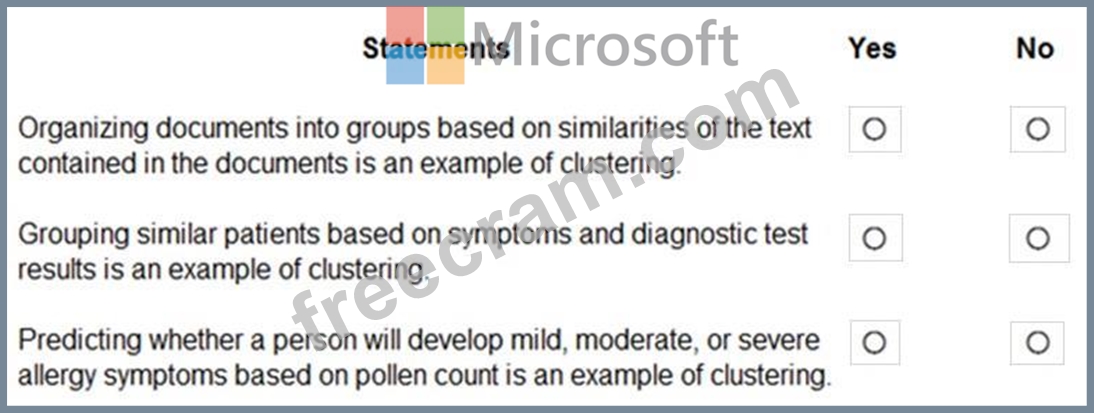
Answer:
Explanation:
Explanation
Graphical user interface, text, application Description automatically generated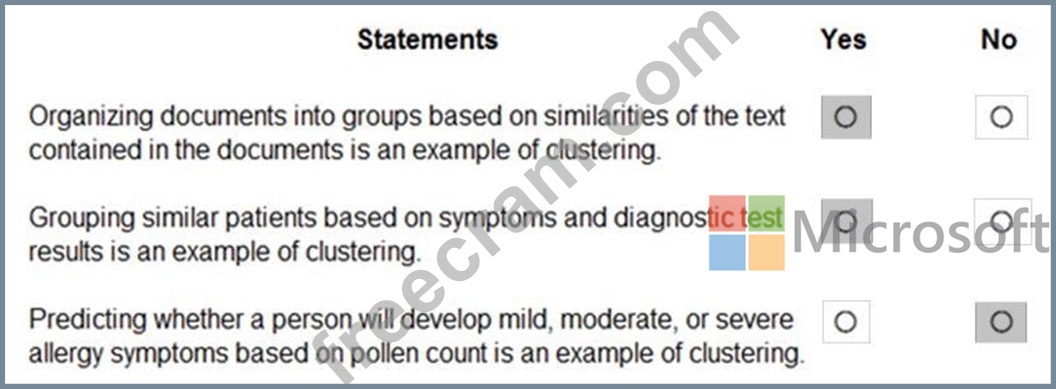
Clustering is a machine learning task that is used to group instances of data into clusters that contain similar characteristics. Clustering can also be used to identify relationships in a dataset Regression is a machine learning task that is used to predict the value of the label from a set of related features.
Reference:
https://docs.microsoft.com/en-us/dotnet/machine-learning/resources/tasks
NEW QUESTION # 31
You build a machine learning model by using the automated machine learning user interface (UI).
You need to ensure that the model meets the Microsoft transparency principle for responsible AI.
What should you do?
- A. Set Validation type to Auto.
- B. Enable Explain best model.
- C. Set Max concurrent iterations to 0.
- D. Set Primary metric to accuracy.
Answer: B
Explanation:
Model Explain Ability.
Most businesses run on trust and being able to open the ML "black box" helps build transparency and trust. In heavily regulated industries like healthcare and banking, it is critical to comply with regulations and best practices. One key aspect of this is understanding the relationship between input variables (features) and model output. Knowing both the magnitude and direction of the impact each feature (feature importance) has on the predicted value helps better understand and explain the model. With model explain ability, we enable you to understand feature importance as part of automated ML runs.
Reference:
https://azure.microsoft.com/en-us/blog/new-automated-machine-learning-capabilities-in-azure-machine-learning-service/
NEW QUESTION # 32
Match the machine learning tasks to the appropriate scenarios.
To answer, drag the appropriate task from the column on the left to its scenario on the right. Each task may be used once, more than once, or not at all.
NOTE: Each correct selection is worth one point.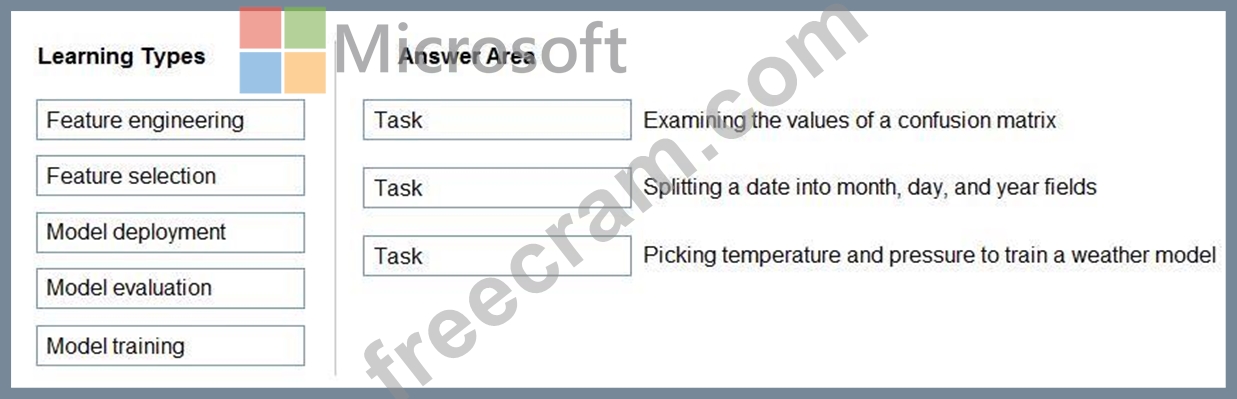
Answer:
Explanation: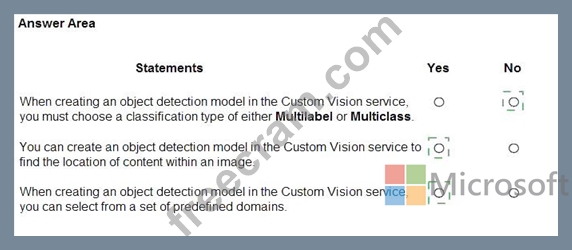
Explanation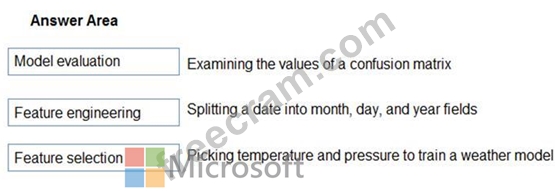
Box 1: Model evaluation
The Model evaluation module outputs a confusion matrix showing the number of true positives, false negatives, false positives, and true negatives, as well as ROC, Precision/Recall, and Lift curves.
Box 2: Feature engineering
Feature engineering is the process of using domain knowledge of the data to create features that help ML algorithms learn better. In Azure Machine Learning, scaling and normalization techniques are applied to facilitate feature engineering. Collectively, these techniques and feature engineering are referred to as featurization.
Note: Often, features are created from raw data through a process of feature engineering. For example, a time stamp in itself might not be useful for modeling until the information is transformed into units of days, months, or categories that are relevant to the problem, such as holiday versus working day.
Box 3: Feature selection
In machine learning and statistics, feature selection is the process of selecting a subset of relevant, useful features to use in building an analytical model. Feature selection helps narrow the field of data to the most valuable inputs. Narrowing the field of data helps reduce noise and improve training performance.
Reference:
https://docs.microsoft.com/en-us/azure/machine-learning/studio/evaluate-model-performance
https://docs.microsoft.com/en-us/azure/machine-learning/concept-automated-ml
NEW QUESTION # 33
Select the answer that correctly completes the sentence.
Answer:
Explanation:
Explanation:
NEW QUESTION # 34
For each of the following statements, select Yes if the statement is true. Otherwise, select No.
NOTE: Each correct selection is worth one point.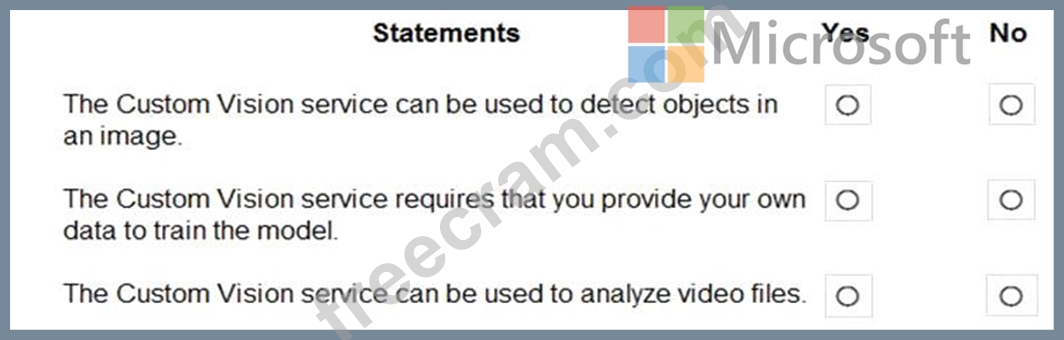
Answer:
Explanation: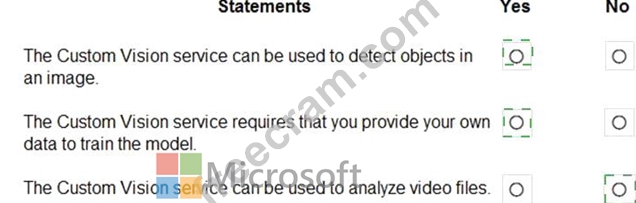
Explanation: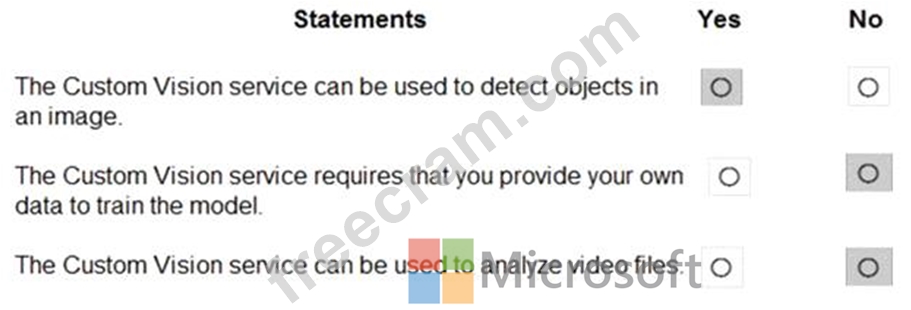
Box 1: Yes
Custom Vision functionality can be divided into two features. Image classification applies one or more labels to an image. Object detection is similar, but it also returns the coordinates in the image where the applied label(s) can be found.
Box 2: Yes
The Custom Vision service uses a machine learning algorithm to analyze images. You, the developer, submit groups of images that feature and lack the characteristics in question. You label the images yourself at the time of submission. Then, the algorithm trains to this data and calculates its own accuracy by testing itself on those same images.
Box 3: No
Custom Vision service can be used only on graphic files.
Reference:
https://docs.microsoft.com/en-us/azure/cognitive-services/Custom-Vision-Service/overview
NEW QUESTION # 35
You need to create a clustering model and evaluate the model by using Azure Machine Learning designer. What should you do?
- A. Split the original dataset into a dataset for training and a dataset for testing. Use the testing dataset for evaluation.
- B. Split the original dataset into a dataset for features and a dataset for labels. Use the features dataset for evaluation.
- C. Split the original dataset into a dataset for training and a dataset for testing. Use the training dataset for evaluation.
- D. Use the original dataset for training and evaluation.
Answer: A
NEW QUESTION # 36
To complete the sentence, select the appropriate option in the answer area.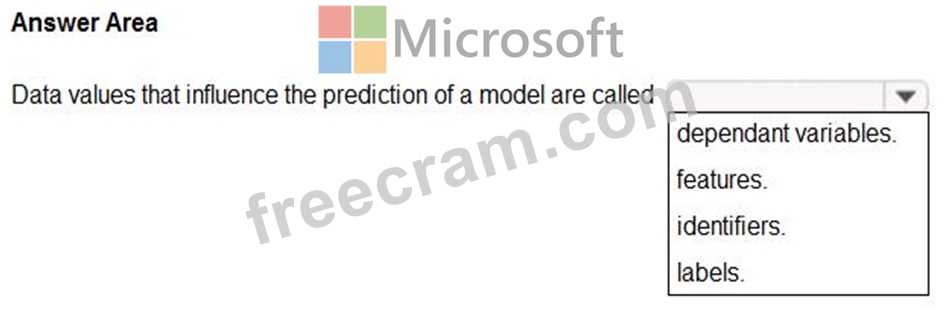
Answer:
Explanation: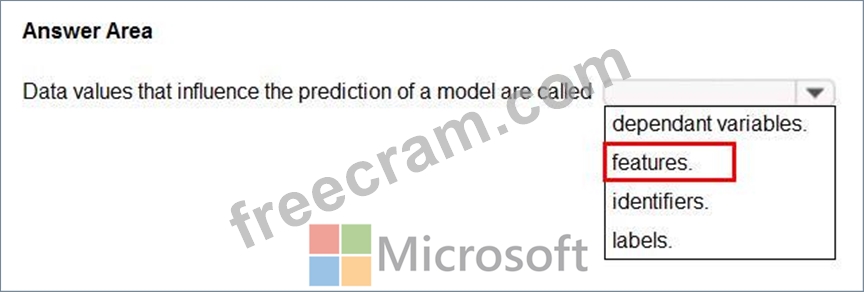
NEW QUESTION # 37
To complete the sentence, select the appropriate option in the answer area.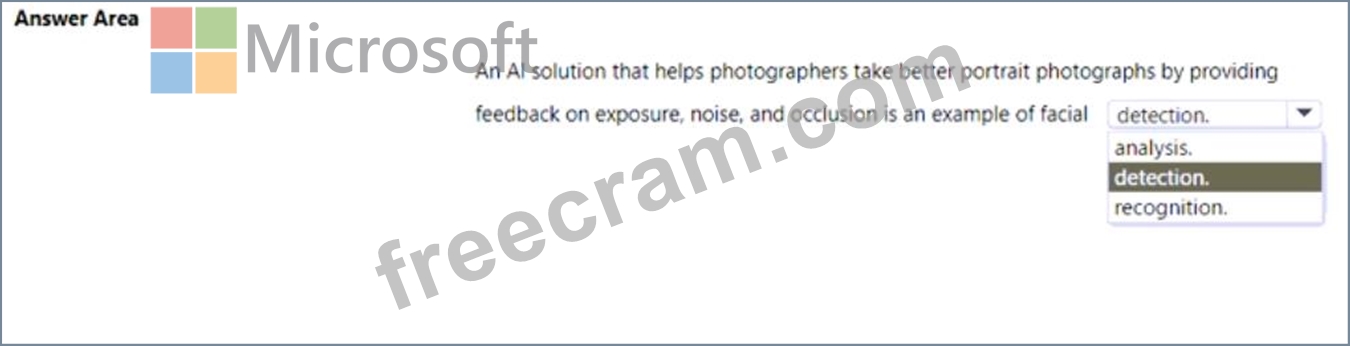
Answer:
Explanation: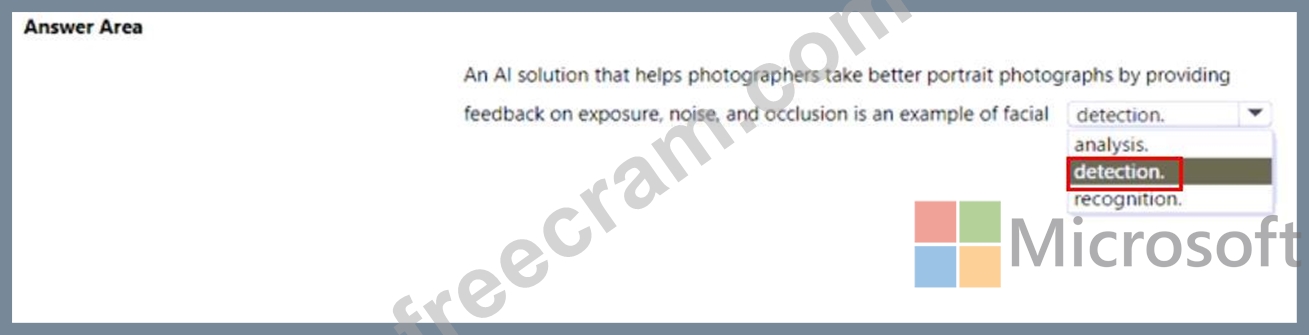
NEW QUESTION # 38
For each of the following statements, select Yes if the statement is true. Otherwise, select No.
NOTE: Each correct selection is worth one point.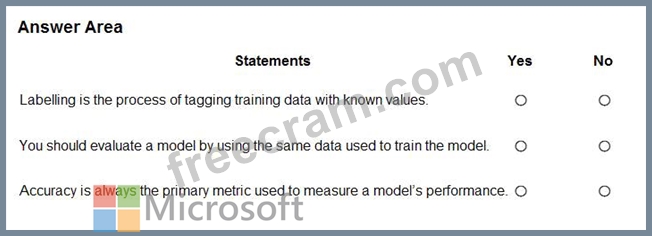
Answer:
Explanation: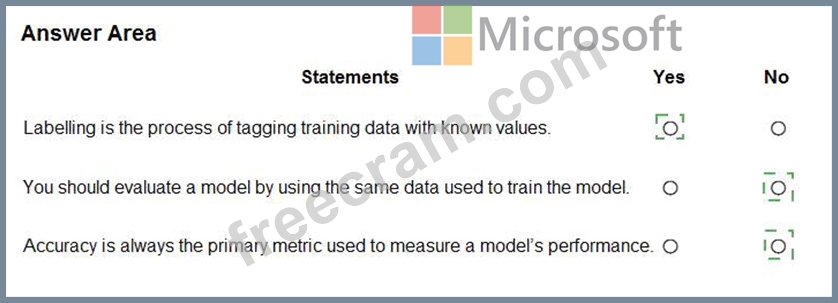
Explanation: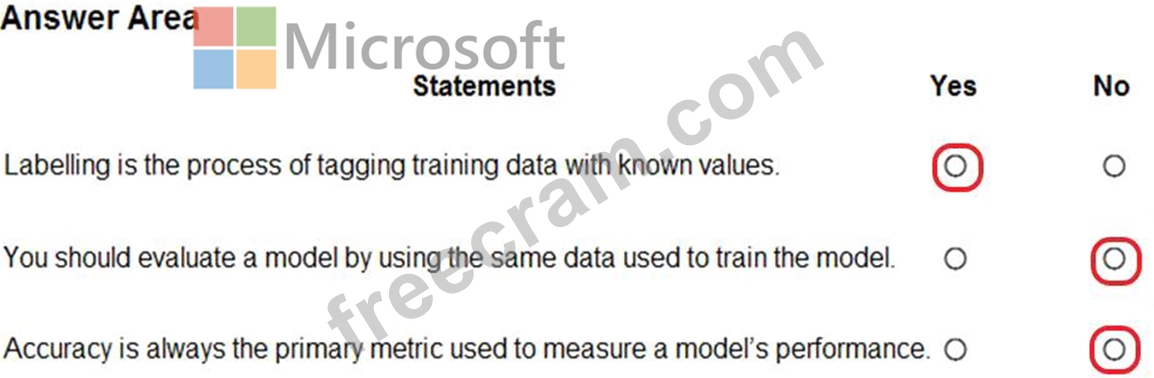
Box 1: Yes
In machine learning, if you have labeled data, that means your data is marked up, or annotated, to show the target, which is the answer you want your machine learning model to predict.
In general, data labeling can refer to tasks that include data tagging, annotation, classification, moderation, transcription, or processing.
Box 2: No
Box 3: No
Accuracy is simply the proportion of correctly classified instances. It is usually the first metric you look at when evaluating a classifier. However, when the test data is unbalanced (where most of the instances belong to one of the classes), or you are more interested in the performance on either one of the classes, accuracy doesn't really capture the effectiveness of a classifier.
Reference:
https://www.cloudfactory.com/data-labeling-guide
https://docs.microsoft.com/en-us/azure/machine-learning/studio/evaluate-model-performance
NEW QUESTION # 39
Match the types of natural languages processing workloads to the appropriate scenarios.
To answer, drag the appropriate workload type from the column on the left to its scenario on the right. Each workload type may be used once, more than once, or not at all.
NOTE: Each correct selection is worth one point.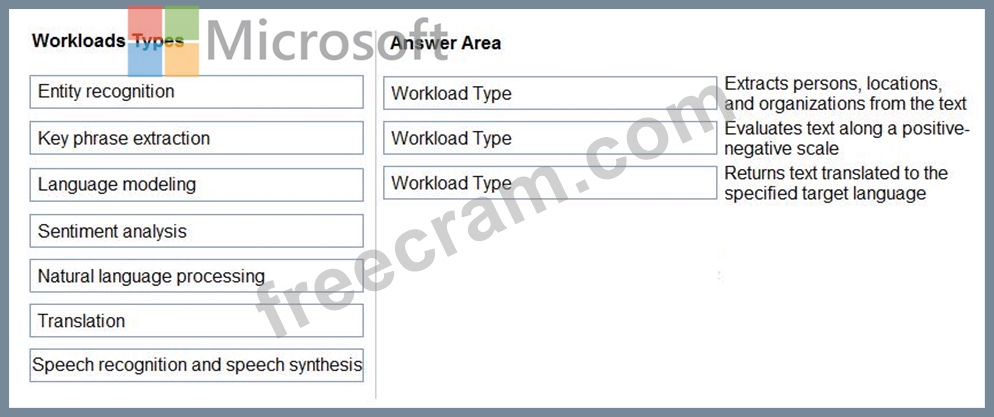
Answer:
Explanation: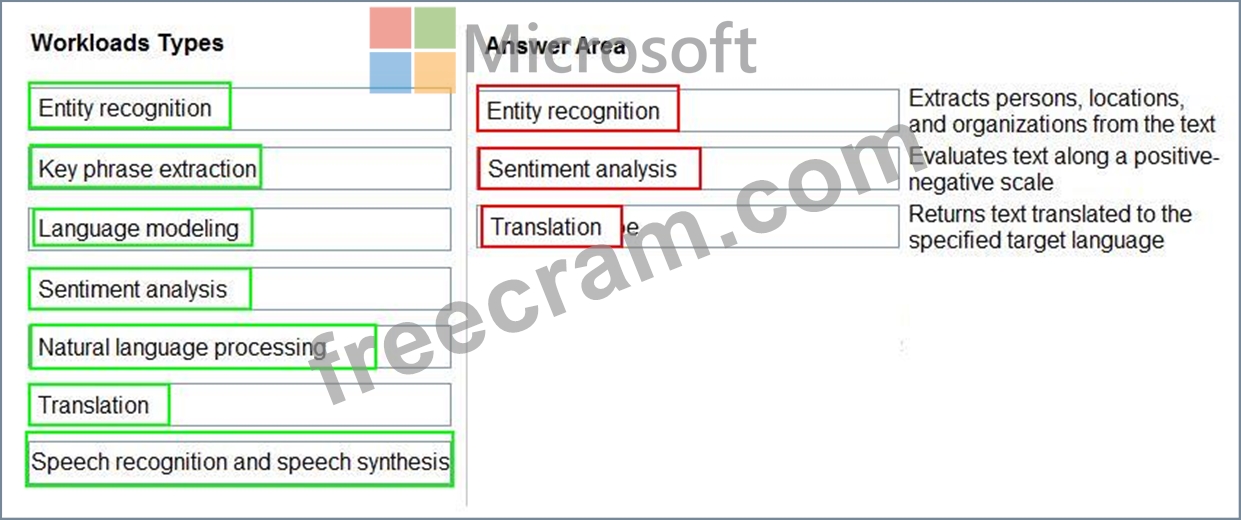
Reference:
https://azure.microsoft.com/en-us/services/cognitive-services/text-analytics
NEW QUESTION # 40
For each of the following statements, select Yes if the statement is true. Otherwise, select No.
NOTE: Each correct selection is worth one point.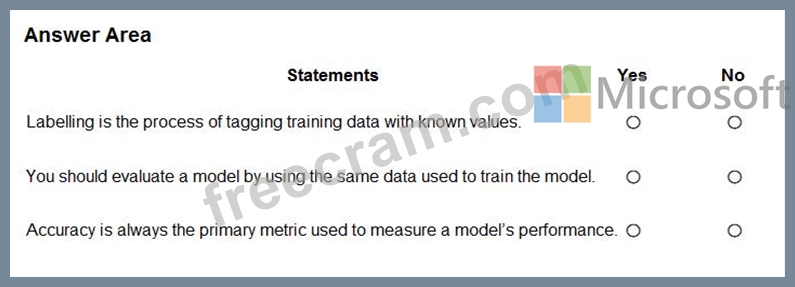
Answer:
Explanation: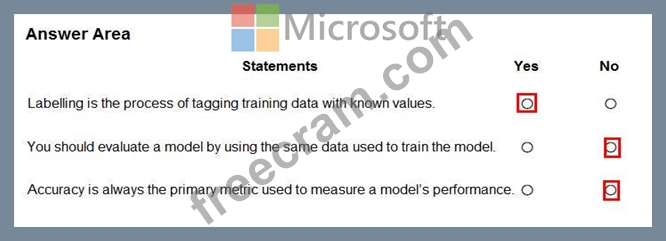
Reference:
https://www.cloudfactory.com/data-labeling-guide
https://docs.microsoft.com/en-us/azure/machine-learning/studio/evaluate-model-performance
NEW QUESTION # 41
Match the Microsoft guiding principles for responsible AI to the appropriate descriptions.
To answer, drag the appropriate principle from the column on the left to its description on the right. Each principle may be used once, more than once, or not at all.
NOTE: Each correct selection is worth one point.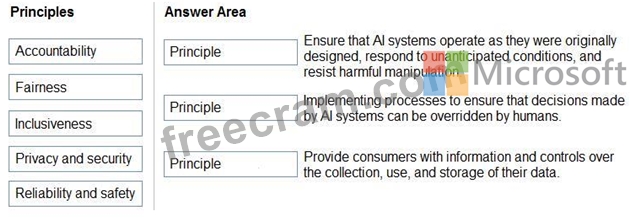
Answer:
Explanation:
Explanation
Box 1: Reliability and safety
To build trust, it's critical that AI systems operate reliably, safely, and consistently under normal circumstances and in unexpected conditions. These systems should be able to operate as they were originally designed, respond safely to unanticipated conditions, and resist harmful manipulation.
Box 2: accountability
Box 3: Privacy and security
As AI becomes more prevalent, protecting privacy and securing important personal and business information is becoming more critical and complex. With AI, privacy and data security issues require especially close attention because access to data is essential for AI systems to make accurate and informed predictions and decisions about people. AI systems must comply with privacy laws that require transparency about the collection, use, and storage of data and mandate that consumers have appropriate controls to choose how their data is used
https://docs.microsoft.com/en-us/learn/modules/responsible-ai-principles/4-guiding-principles
NEW QUESTION # 42
Select the answer that correctly completes the sentence.
Answer:
Explanation:
NEW QUESTION # 43
You have the following dataset.
You plan to use the dataset to train a model that will predict the house price categories of houses.
What are Household Income and House Price Category? To answer, select the appropriate option in the answer area.
NOTE: Each correct selection is worth one point.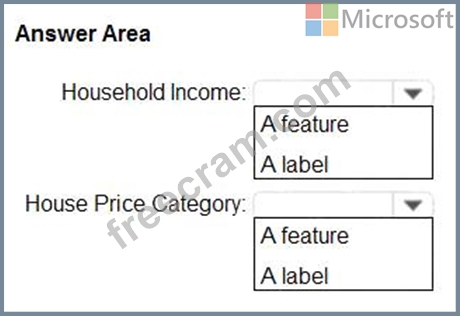
Answer:
Explanation: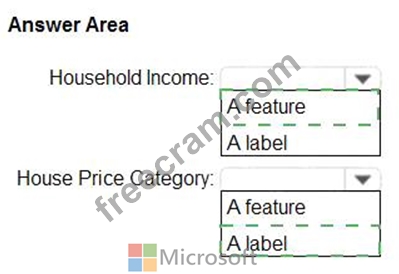
Explanation: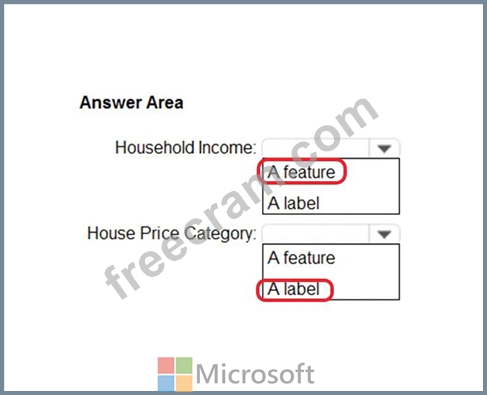
Box 1: A feature
Box 2: A label
Reference:
https://docs.microsoft.com/en-us/azure/machine-learning/studio/interpret-model-results
NEW QUESTION # 44
Which type of machine learning should you use to predict the number of gift cards that will be sold next month?
- A. regression
- B. clustering
- C. classification
Answer: A
Explanation:
Section: Describe fundamental principles of machine learning on Azure
Explanation:
In the most basic sense, regression refers to prediction of a numeric target.
Linear regression attempts to establish a linear relationship between one or more independent variables and a numeric outcome, or dependent variable.
You use this module to define a linear regression method, and then train a model using a labeled dataset. The trained model can then be used to make predictions.
Reference:
https://docs.microsoft.com/en-us/azure/machine-learning/studio-module-reference/linear-regression
NEW QUESTION # 45
......
About Exam AI-900
The interested candidate for the Microsoft AI-900 test, which also goes under the name the Azure test for AI Fundamentals, should have at least some foundational understanding of the concept of AI features alongside ML ones. This exam will test the entrant's knowledge of different AI common workloads, principles of AI and ML, NLP workloads, and other related concepts. When it comes to the details for this exam, the Microsoft AI-900 is available in several languages, among which you'll find Spanish, English, Korean, German, Chinese (Simplified), and French. Such an exam comes with a registration fee of $99 and should be scheduled through Pearson VUE. Also, in the main exam, candidates will be exposed to around 40-60 tasks with 1 hour given to solve them.
Microsoft AI-900 (Microsoft Azure AI Fundamentals) Certification Exam is designed to validate the foundational understanding of AI and its applications in Azure. It is an excellent entry-level certification for individuals who want to develop their knowledge of AI and how it can be leveraged in Azure. AI-900 exam is suitable for anyone interested in AI, including business decision-makers, technical salespeople, developers, and IT professionals.
Check the Free demo of our AI-900 Exam Dumps with 321 Questions: https://www.freecram.com/Microsoft-certification/AI-900-exam-dumps.html
Verified AI-900 Q&As - Pass Guarantee AI-900 Exam Dumps: https://drive.google.com/open?id=1WQqvnqxRnbGIIO-xz_GVyiJ9h6pb8wi_