

[Apr-2026] Pass EC-COUNCIL 312-39 Exam in First Attempt Guaranteed!
Full 312-39 Practice Test and 202 unique questions with explanations waiting just for you, get it now!
NEW QUESTION # 22
In which phase of Lockheed Martin's - Cyber Kill Chain Methodology, adversary creates a deliverable malicious payload using an exploit and a backdoor?
- A. Exploitation
- B. Weaponization
- C. Delivery
- D. Reconnaissance
Answer: B
Explanation: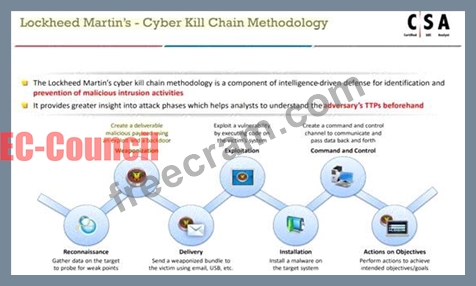
NEW QUESTION # 23
Which of the following is a default directory in a Mac OS X that stores security-related logs?
- A. /Library/Logs/Sync
- B. /var/log/cups/access_log
- C. ~/Library/Logs
- D. /private/var/log
Answer: D
Explanation:
The default directory in Mac OS X that stores security-related logs is /private/var/log. This directory is used by the system to keep various log files, which include security-related information. These logs can provide valuable insights for a Security Operations Center (SOC) analyst when monitoring and analyzing security events on Mac OS systems.
References: The EC-Council's Certified SOC Analyst (CSA) program covers the importance of understanding the logging mechanisms of different operating systems, including Mac OS X. The /private/var/log directory is a critical location for SOC analysts to monitor, as it contains logs that can be used to track security incidents and anomalies12.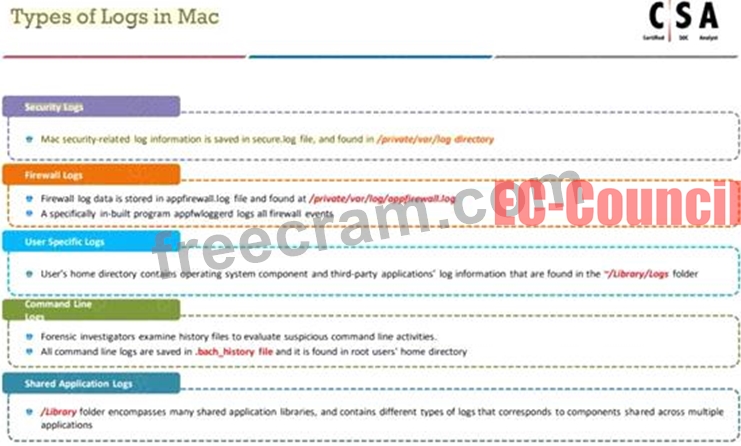
NEW QUESTION # 24
Which of the following attack can be eradicated by converting all non-alphanumeric characters to HTML character entities before displaying the user input in search engines and forums?
- A. WebServices Attacks
- B. Broken Access Control Attacks
- C. Session Management Attacks
- D. XSS Attacks
Answer: D
Explanation:
Converting all non-alphanumeric characters to HTML character entities is a common defense against Cross- Site Scripting (XSS) attacks. Here's how it works:
* User Input Sanitization: When user input is received, the system converts characters like <, >, &, ', and " into their corresponding HTML entities (e.g., <, >, &, ', and ").
* Preventing Script Execution: By converting these characters, the system prevents potentially malicious scripts from being executed in the browser of anyone viewing the content.
* Maintaining Data Integrity: This process allows user-generated content to be displayed without altering the intended message while ensuring the content cannot harm other users or the system.
References:
EC-Council's Certified SOC Analyst (C|SA) course material covers various cybersecurity threats, including XSS attacks, and the methods used to mitigate them.
The study guides and resources provided by EC-Council for the SOC Analyst certification include detailed explanations of XSS attacks and the importance of sanitizing user input to prevent such vulnerabilities1234 Reference: https://ktflash.gitbooks.io/ceh_v9/content/125_countermeasures.html
NEW QUESTION # 25
Which of the following are the responsibilities of SIEM Agents?
1.Collecting data received from various devices sending data to SIEM before forwarding it to the central engine.
2.Normalizing data received from various devices sending data to SIEM before forwarding it to the central engine.
3.Co-relating data received from various devices sending data to SIEM before forwarding it to the central engine.
4.Visualizing data received from various devices sending data to SIEM before forwarding it to the central engine.
- A. 2 and 3
- B. 3 and 1
- C. 1 and 4
- D. 1 and 2
Answer: D
Explanation: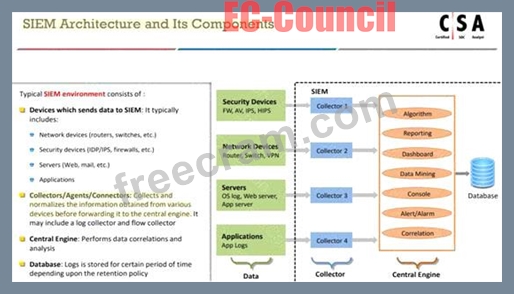
NEW QUESTION # 26
Which of the following is a correct flow of the stages in an incident handling and response (IH&R) process?
- A. Preparation -> Incident Recording -> Incident Triage -> Containment -> Eradication -> Recovery -> Post-Incident Activities
- B. Containment -> Incident Recording -> Incident Triage -> Preparation -> Recovery -> Eradication -> Post-Incident Activities
- C. Incident Triage -> Eradication -> Containment -> Incident Recording -> Preparation -> Recovery -> Post-Incident Activities
- D. Incident Recording -> Preparation -> Containment -> Incident Triage -> Recovery -> Eradication -> Post-Incident Activities
Answer: A
Explanation:
The correct flow of stages in an Incident Handling and Response (IH&R) process typically follows a structured approach that begins with Preparation, which is crucial for an effective response to incidents. This is followed by Incident Recording, where details of the incident are documented. Incident Triage is the next stage, where incidents are prioritized based on their impact. Containment strategies are then employed to limit the spread of the incident. Eradication involves removing the threat from the affected systems. Recovery is the process of restoring systems to normal operation. Finally, Post-Incident Activities involve learning from the incident and improving future response efforts.
References: The stages of the IH&R process are outlined in various EC-Council resources, including the EC-Council's Certified Incident Handler (E|CIH) program and related training materials, which emphasize the importance of a structured and methodical approach to incident handling and response123.
NEW QUESTION # 27
A SOC team notices malware-related incidents increased over the past six months, primarily targeting endpoints through phishing campaigns. They need to present a report to security leadership to justify investing in advanced email filtering and end-user security training. Which SOC report best supports their case?
- A. Monitoring summary report
- B. Real-time monitoring report
- C. Trend analysis report
- D. Incident report
Answer: C
Explanation:
A trend analysis report is designed to show how incident frequency, types, severity, and impact change over time, which is exactly what leadership needs for investment decisions. The scenario is about demonstrating an increase in malware incidents over six months and linking them to phishing as an entry vector. A trend report can quantify growth rates, highlight recurring patterns, identify peak periods, compare pre- and post-control effectiveness, and estimate business risk (downtime, remediation hours, affected users). This supports a clear business case for budget: if phishing-driven malware is increasing, investments in email filtering and user training directly address the root cause and should reduce future incident volume. A monitoring summary report may provide a snapshot but often lacks time-series depth. A real-time monitoring report focuses on current status and active alerts, not long-term justification. An incident report is typically focused on a single event and is useful for lessons learned but not for demonstrating systemic trends. From a SOC management perspective, trend analysis aligns technical evidence with strategic decisions, making it the most effective report type to support funding for preventive controls and awareness programs.
NEW QUESTION # 28
Banter is a threat analyst in Christine Group of Industries. As a part ofthe job, he is currently formatting and structuring the raw data.
He is at which stage of the threat intelligence life cycle?
- A. Collection
- B. Processing and Exploitation
- C. Analysis and Production
- D. Dissemination and Integration
Answer: B
Explanation:
In thethreat intelligence life cycle, the stage of Processing and Exploitation involves the formatting and structuring of raw data. This is the phase where collected data is turned into a format that can be more easily analyzed and used. Banter, as a threat analyst, is engaged in this specific activity, which indicates that he is in the Processing and Exploitation stage. This stage is crucial as it prepares the data for further analysis and production of actionable intelligence.
References: The EC-Council's Certified Threat Intelligence Analyst (C|TIA) program outlines the threat intelligence life cycle and defines the Processing and Exploitation stage as the point where data is organized and prepared for analysis. This information is detailed in the EC-Council's official training and certification resources for the SOC Analyst role12.
Reference: https://socradar.io/5-stages-of-the-threat-intelligence-lifecycle/
NEW QUESTION # 29
Which of the following formula represents the risk?
- A. Risk = Likelihood * Severity * Asset Value
- B. Risk = Likelihood * Consequence * Severity
- C. Risk = Likelihood * Impact * Asset Value
- D. Risk = Likelihood * Impact * Severity
Answer: C
Explanation: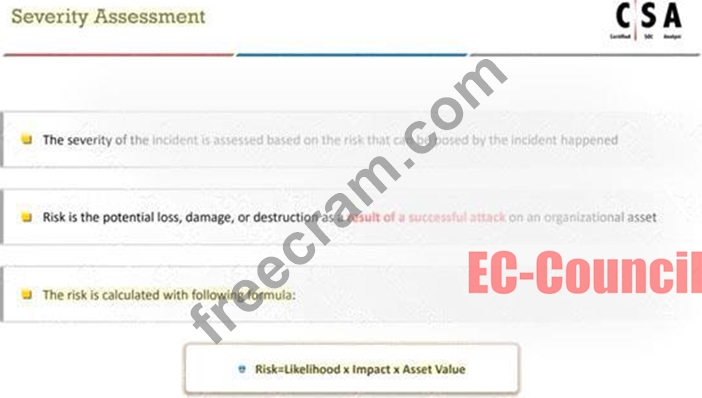
NEW QUESTION # 30
According to the Risk Matrix table, what will be the risk level when the probability of an attack is very high, and the impact of that attack is major?
NOTE: It is mandatory to answer the question before proceeding to the next one.
- A. High
- B. Low
- C. Medium
- D. Extreme
Answer: D
Explanation:
In a Risk Matrix, risk levels are determined by the intersection of the likelihood of anoccurrence (probability) and the consequence of that occurrence (impact). When the probability of an event is very high and the impact is major, it typically falls into the 'Extreme' category. This is because the combination of a high likelihood and major impact represents a scenario where the risk is unacceptable and requires immediate attention and mitigation measures.
References: The EC-Council's Certified SOC Analyst (CSA) course materials and study guides provide detailed information onassessing risks using a Risk Matrix. The course emphasizes the importance of understanding the Risk Matrix for effective security operations center (SOC) analysis. For more in-depth information, refer to the official EC-Council CSA study materials and resources12.
Reference: https://onlinelibrary.wiley.com/page/journal/15396924/homepage/ special_issue simple_characterisations_and_communication_of_risks.htm
NEW QUESTION # 31
At a large healthcare organization, the Security Operations Center (SOC) detects a surge of failed login attempts on employee accounts, indicating a possible brute-force attack. To contain the threat, the team quickly takes action to prevent unauthorized access. However, they also need to implement a security measure that strengthens account protection beyond just stopping the current attack, reducing the risk of similar incidents in the future. During the Containment Phase, which action would best enhance long-term account security against brute-force attacks?
- A. Enable multi-factor authentication (MFA)
- B. Cross-verify false positives
- C. Notify affected users
- D. Block IP addresses and enforce account lockout policies
Answer: A
Explanation:
MFA is the most effective long-term control among the options because it directly reduces the attacker's ability to succeed even when passwords are guessed, reused, or stolen. Brute-force and credential stuffing attacks exploit the single-factor nature of passwords; MFA adds an additional verification factor (authenticator app prompt, FIDO2 key, certificate-based auth), making account takeover significantly harder.
From a containment standpoint, blocking IPs and enabling lockout can reduce immediate attack volume, but attackers commonly rotate IPs, use botnets, or target many accounts in parallel, which can also cause operational impact via account lockouts (denial of service against users). Cross-verifying false positives is important for accuracy, but it does not strengthen security. Notifying users can help awareness but is not a technical control. In SOC operations, the best practice is layered containment: immediate throttling/blocks and lockout tuning for the active attack, followed by durable hardening controls. MFA is the durable hardening step that meaningfully reduces future brute-force success rates and complements conditional access policies (geo/time/device risk) and stronger password protections.
NEW QUESTION # 32
CyberBank has experienced phishing, insider threats, and attempted data breaches targeting customer financial records. The bank operates across multiple regions and needs a solution offering continuous security monitoring, rapid threat detection, and centralized visibility across all branches. Which solution will provide automated alerting, digital forensics capabilities, and active threat hunting?
- A. Implementing a Security Operations Center (SOC)
- B. Deploying a standalone SIEM (Security Information and Event Management) system
- C. Implementing SOAR (Security Orchestration, Automation, and Response)
- D. Implementing periodic security audits
Answer: A
Explanation:
A SOC is the operational capability that combines people, process, and technology to deliver continuous monitoring, detection, investigation, and response across an organization. The question requires automated alerting, forensics capability, and active threat hunting. Those are SOC functions when supported by the right tooling (SIEM/EDR/XDR, forensic workflows, playbooks) and staffed analysts. A standalone SIEM provides log aggregation and alerting but does not inherently provide threat hunting and forensics expertise without dedicated analysts and processes. SOAR automates workflows but depends on upstream detections and a team to design and operate playbooks; it does not replace continuous monitoring, investigation, and hunting.
Periodic audits are point-in-time checks and cannot deliver rapid detection/response. From a SOC analyst perspective, a SOC provides centralized visibility, 24/7 coverage, triage and escalation, proactive hunts, coordination with incident response, and structured reporting-especially important for multi-region banking environments with high regulatory exposure. Therefore, implementing a SOC is the solution that best meets the full set of requirements.
NEW QUESTION # 33
A large financial services company has experienced increasing sophisticated threats targeting critical assets.
The SOC primarily focuses on log collection and basic monitoring, but incidents revealed gaps in detecting and responding to advanced threats proactively. Management decides to adopt the SOC Capability Maturity Model (CMM). The initial assessment indicates the SOC is at Level 1, and the organization aims to reach Level 3 by enhancing incident response procedures, improving threat intelligence integration, establishing KPIs, automating triage, implementing behavior-based analytics, and creating continuous training. Based on the SOC CMM, what should be the first priority in transitioning from Level 1 to Level 3?
- A. Outsourcing SOC operations to an MSSP
- B. Implementing AI-driven automation for real-time detection and response
- C. Deploying advanced deception technologies
- D. Establishing well-defined and repeatable incident response processes
Answer: D
Explanation:
Moving from a low-maturity SOC to a more capable, repeatable operation requires a stable operational foundation before advanced technology layers. Establishing well-defined and repeatable incident response processes is the correct first priority because it creates consistency in how alerts are triaged, escalated, contained, investigated, and documented. At Level 1, organizations often operate ad hoc: inconsistent handoffs, unclear severity criteria, and weak documentation. Without standardized processes and playbooks, adding AI automation or deception technologies can amplify confusion or trigger disruptive actions based on poorly understood signals. Repeatable IR processes also enable measurement-KPIs like MTTA/MTTR, false positive rates, and containment effectiveness-which is essential to progress to Level 3 maturity. Threat intelligence integration and behavior analytics become far more effective when the SOC has defined workflows to consume intelligence, update detections, and execute response steps predictably. Outsourcing is a resourcing model choice rather than a maturity prerequisite. Therefore, the first step is building structured, documented, consistently executed incident response procedures that create the platform for tuning, automation, and advanced analytics.
NEW QUESTION # 34
A healthcare organization's SIEM detects unusual HTTP requests targeting its patient portal. The requests originate from a foreign IP address and occur during non-business hours. The methods used are primarily TRACE and OPTIONS, which are rarely seen in normal web traffic. The SIEM correlates these with increased reconnaissance activity on other servers within the same subnet. What is the primary security concern with TRACE and OPTIONS requests?
- A. They expose information about server-supported methods and request headers
- B. They allow attackers to bypass authentication controls
- C. They can be used to upload malicious payloads directly to the server
- D. They make Distributed Denial of Service (DDoS) attacks easier
Answer: A
Explanation:
TRACE and OPTIONS are often associated with reconnaissance because they can reveal how a server is configured and what capabilities it supports. OPTIONS can disclose which HTTP methods are allowed (GET, POST, PUT, DELETE, etc.), helping attackers identify whether risky methods are enabled or misconfigured.
TRACE can be abused to reflect request headers back to the client, which may expose sensitive header information in certain misconfigurations and historically has been associated with cross-site tracing risks. In SOC investigations, unusual usage of TRACE/OPTIONS-especially from foreign IPs and outside business hours-often indicates probing to map the attack surface before selecting an exploit path. Uploading payloads is more associated with PUT/POST to vulnerable endpoints, not primarily TRACE/OPTIONS. DDoS facilitation is not a primary characteristic of these methods. Authentication bypass is not an inherent feature of TRACE/OPTIONS; attackers still need a separate vulnerability to bypass auth. Because the question asks for the primary concern, the best answer is that these methods can reveal supported methods and header behavior, increasing attacker knowledge and enabling follow-on exploitation attempts.
NEW QUESTION # 35
Which of the following attack can be eradicated by filtering improper XML syntax?
- A. CAPTCHA Attacks
- B. SQL Injection Attacks
- C. Insufficient Logging and Monitoring Attacks
- D. Web Services Attacks
Answer: D
Explanation:
Web services attacks can be mitigated by filtering improper XML syntax because these attacks often exploit vulnerabilities in web services that accept XML input. XML filtering ensures that only properly formatted XML data is processed by the web service. This can prevent various forms of XML-related attacks, such as XML injection or XML External Entity (XXE) attacks, where attackers attempt to interfere with the processing of XML data.
References: The EC-Council's Certified SOC Analyst (CSA) program covers the fundamentals of SOC operations, including the identification and validation of intrusion attempts, and the use of SIEM solutions for enhanced threat detection. The program emphasizes the importance of understanding the various types of attacks and the appropriate defensive measures, including the filtering of improper XML syntax to protect against web services attacks12.
NEW QUESTION # 36
An attacker exploits the logic validation mechanisms of an e-commerce website. He successfully purchases a product worth $100 for $10 by modifying the URL exchanged between the client and the server.
Original
URL: http://www.buyonline.com/product.aspx?profile=12
&debit=100
Modified URL: http://www.buyonline.com/product.aspx?profile=12
&debit=10
Identify the attack depicted in the above scenario.
- A. Session Fixation Attack
- B. SQL Injection Attack
- C. Parameter Tampering Attack
- D. Denial-of-Service Attack
Answer: C
Explanation:
The scenario described involves an attacker modifying the URL parameters to alter the price of a product, which is a classic example of a Parameter Tampering attack. This type of attack occurs when an attacker manipulates parameters exchanged between client and server in order to modify application data, such as user credentials, permissions, and price of products, as seen in this case.
The original URL indicates that the product price (debit) is set to $100. The attacker has modified this parameter value to $10 in the modified URL, thus exploiting the logic validation mechanism of the e-commerce website to purchase the product at a lower price. This manipulation of parameters is indicative of a Parameter Tampering attack, which is a form of web-based attack where the properties of a web application are altered to achieve unintended outcomes by the attacker.
References: The EC-Council's Certified SOC Analyst (CSA) course material covers various types of cyber attacks, including Parameter Tampering. The CSA study guides and resources provide detailed information on how to identify and respond to such attacks, emphasizing the importance of validating and sanitizing all inputs and parameters to prevent exploitation.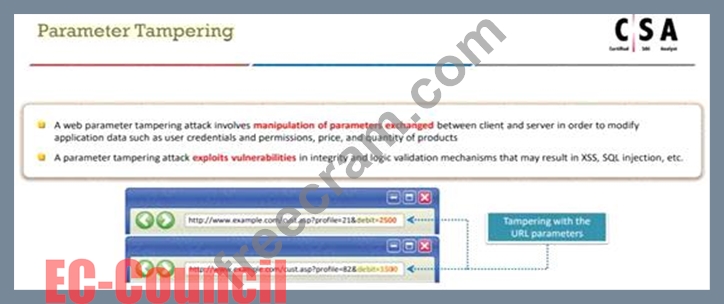
NEW QUESTION # 37
Mike is an incident handler for PNP Infosystems Inc. One day, there was a ticket raised regarding a critical incident and Mike was assigned to handle the incident. During the process of incident handling, at one stage, he has performed incident analysis and validation to check whether the incident is a true incident or a false positive.
Identify the stage in which he is currently in.
- A. Post-Incident Activities
- B. Incident Triage
- C. Incident Recording and Assignment
- D. Incident Disclosure
Answer: B
Explanation:
The stage of incident handling that involves incident analysis and validation to determine if the incident is a true incident or a false positive is known as Incident Triage. This stage is critical as it helps in prioritizing incidents based on their severity, impact, and urgency. The process of triage typically includes an initial assessment to confirm the validity of an incident, categorize its type, and determine the appropriate response.
References: The EC-Council's SOC Analyst course outlines the incident handling and response process, which includes the triage stage as a key component12. This is further supported by the NIST framework, which details the stages of incident response, including detection and analysis, where triage is a fundamental activity1. The Certified SOC Analyst (CSA) training also emphasizes the importance of incident triage in the overall security operations center (SOC) workflow3.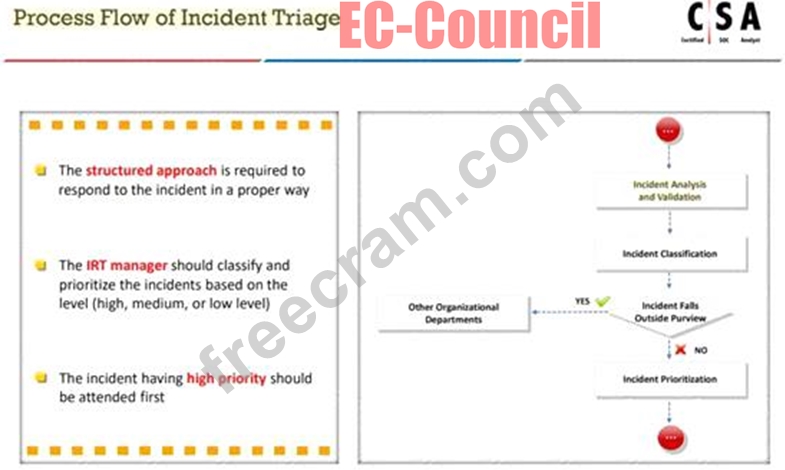
NEW QUESTION # 38
John, a SOC analyst, while monitoring and analyzing Apache web server logs, identified an event log matching Regex /(\.|(%|%25)2E)(\.|(%|%25)2E)(\/|(%|%25)2F|\\|(%|%25)5C)/i.
What does this event log indicate?
- A. SQL injection Attack
- B. XSS Attack
- C. Parameter Tampering Attack
- D. Directory Traversal Attack
Answer: B
NEW QUESTION # 39
Which of the following formula represents the risk levels?
- A. Level of risk = Consequence × Impact
- B. Level of risk = Consequence × Asset Value
- C. Level of risk =Consequence × Likelihood
- D. Level of risk = Consequence × Severity
Answer: C
Explanation:
The level of risk is typically calculated by considering the consequence (or impact) of an event and the likelihood (or probability) of its occurrence. The formula represents a fundamental risk assessment concept where risk is the product of the two factors:
* Consequence (Impact): The outcome or result if a threat does exploit a vulnerability.
* Likelihood (Probability): The chance that a given threat will exploit a vulnerability.
By multiplying these two factors, one can determine the level of risk, which helps in prioritizing risks and deciding on the appropriate level of controls and mitigation strategies.
References: The EC-Council's Certified SOC Analyst (CSA) course materials and study guides cover the concepts of risk assessment and management, which include the formula for calculating risk levels as the product of consequence and likelihood. These concepts are aligned with industry best practices and standards for security operations centers.
NEW QUESTION # 40
Mike is an incident handler for PNP Infosystems Inc. One day, there was a ticket raised regarding a critical incident and Mike was assigned to handle the incident. During the process of incident handling, at one stage, he has performed incident analysis and validation to check whether the incident is a true incident or a false positive.
Identify the stage in which he is currently in.
- A. Post-Incident Activities
- B. Incident Triage
- C. Incident Recording and Assignment
- D. Incident Disclosure
Answer: B
Explanation:
The stage of incident handling that involves incident analysis and validation to determine if the incident is a true incident or a false positive is known as Incident Triage. This stage is critical as it helps in prioritizing incidents based on their severity, impact, and urgency. The process of triage typically includes an initial assessment to confirm the validity of an incident, categorize its type, and determine the appropriate response.
References: The EC-Council's SOC Analyst course outlines the incident handling and response process, which includes the triage stage as a key component12. This is further supported by the NIST framework, which details the stages of incident response, including detection and analysis, where triage is a fundamental activity1. The Certified SOC Analyst (CSA) training also emphasizes the importance of incident triage in the overall security operations center (SOC) workflow3.
NEW QUESTION # 41
InfoSystem LLC, a US-based company, is establishing an in-house SOC. John has been given the responsibility to finalize strategy, policies, and procedures for the SOC.
Identify the job role of John.
- A. Security Analyst - L1
- B. Security Analyst - L2
- C. Chief Information Security Officer (CISO)
- D. Security Engineer
Answer: C
NEW QUESTION # 42
Which encoding replaces unusual ASCII characters with "%" followed by the character's two-digit ASCII code expressed in hexadecimal?
- A. URL Encoding
- B. Unicode Encoding
- C. UTF Encoding
- D. Base64 Encoding
Answer: A
Explanation:
URL encoding, also known as percent-encoding, is a mechanism for encoding information in a Uniform Resource Identifier (URI) under certain circumstances. When characters are not allowed in a URI, they are replaced with a percent sign (%) followed by two hexadecimal digits that represent the ASCII code of the character. For example, a space character is not allowed in a URI and is replaced with %20.
References:The answer is verified as per the EC-Council's Certified SOC Analyst (CSA) course materials and study guides, which discuss various encoding schemes used in cybersecurity practices. URL encoding is specifically mentioned as the method for replacing unusual ASCII characters with a percent sign followed by two hexadecimal digits123.
Reference: https://ktflash.gitbooks.io/ceh_v9/content/125_countermeasures.html
NEW QUESTION # 43
Which of the following contains the performance measures, and proper project and time management details?
- A. Incident Response Process
- B. Incident Response Procedures
- C. Incident Response Tactics
- D. Incident Response Policy
Answer: D
Explanation: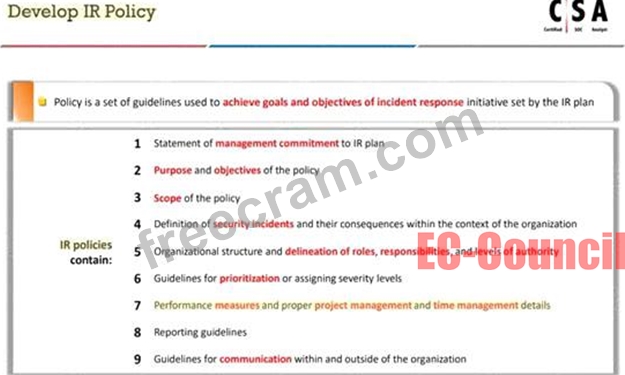
NEW QUESTION # 44
......
Prepare for your EC-COUNCIL certification with the updated FreeCram 312-39 exam questions: https://drive.google.com/open?id=1A32i2RdyWXiWnTGm9NYeVYf_67pHuznZ
Get Latest 312-39 Dumps Exam Questions in here: https://www.freecram.com/EC-COUNCIL-certification/312-39-exam-dumps.html