

[Sep 14, 2023] Free CompTIA Cybersecurity Analyst CS0-003 Exam Question
CS0-003 dumps & CompTIA Cybersecurity Analyst sure practice dumps
CompTIA Cybersecurity Analyst (CySA+) Certification is a globally recognized certification that is designed for IT professionals who are involved in the cybersecurity field. It is an intermediate-level certification that covers a wide range of cybersecurity topics, including threat management, vulnerability management, incident response, and compliance and assessment. CompTIA Cybersecurity Analyst (CySA+) Certification Exam certification is ideal for professionals who are looking to advance their careers in cybersecurity and want to demonstrate their skills and knowledge in this field.
The CS0-003 certification exam measures a candidate's ability to identify and analyze cybersecurity threats, vulnerabilities, and risks, and to design and implement effective security solutions that can protect computer systems and networks against cyber attacks. CS0-003 exam covers a range of topics such as threat detection, incident response, security analytics, and vulnerability management.
NEW QUESTION # 25
Which of the following is an important aspect that should be included in the lessons-learned step after an incident?
- A. Present all legal evidence collected and turn it over to iaw enforcement
- B. Determine if an internal mistake was made and who did it so they do not repeat the error
- C. Identify any improvements or changes in the incident response plan or procedures
- D. Discuss the financial impact of the incident to determine if security controls are well spent
Answer: C
Explanation:
An important aspect that should be included in the lessons-learned step after an incident is to identify any improvements or changes in the incident response plan or procedures. The lessons-learned step is a process that involves reviewing and evaluating the incident response activities and outcomes, as well as identifying and documenting any strengths, weaknesses, gaps, or best practices. Identifying any improvements or changes in the incident response plan or procedures can help enhance the security posture, readiness, or capability of the organization for future incidents
NEW QUESTION # 26
An analyst recommends that an EDR agent collect the source IP address, make a connection to the firewall, and create a policy to block the malicious source IP address across the entire network automatically. Which of the following is the best option to help the analyst implement this recommendation?
- A. SLA
- B. SOAR
- C. SIEM
- D. IoC
Answer: B
Explanation:
Explanation
SOAR (Security Orchestration, Automation, and Response) is the best option to help the analyst implement the recommendation, as it reflects the software solution that enables security teams to integrate and coordinate separate tools into streamlined threat response workflows and automate repetitive tasks. SOAR is a term coined by Gartner in 2015 to describe a technology that combines the functions of security incident response platforms, security orchestration and automation platforms, and threat intelligence platforms in one offering.
SOAR solutions help security teams to collect inputs from various sources, such as EDR agents, firewalls, or SIEM systems, and perform analysis and triage using a combination of human and machine power. SOAR solutions also allow security teams to define and execute incident response procedures in a digital workflow format, using automation to perform low-level tasks or actions, such as blocking an IP address or quarantining a device. SOAR solutions can help security teams to improve efficiency, consistency, and scalability of their operations, as well as reduce mean time to detect (MTTD) and mean time to respond (MTTR) to threats. The other options are not as suitable as SOAR, as they do not match the description or purpose of the recommendation. SIEM (Security Information and Event Management) is a software solution that collects and analyzes data from various sources, such as logs, events, or alerts, and provides security monitoring, threat detection, and incident response capabilities. SIEM solutions can help security teams to gain visibility, correlation, and context of their security data, but they do not provide automation or orchestration features like SOAR solutions. SLA (Service Level Agreement) is a document that defines the expectations and responsibilities between a service provider and a customer, such as the quality, availability, or performance of the service. SLAs can help to manage customer expectations, formalize communication, and improve productivity and relationships, but they do not help to implement technical recommendations like SOAR solutions. IoC (Indicator of Compromise) is a piece of data or evidence that suggests a system or network has been compromised by a threat actor, such as an IP address, a file hash, or a registry key. IoCs can help to identify and analyze malicious activities or incidents, but they do not help to implement response actions like SOAR solutions.
NEW QUESTION # 27
A user downloads software that contains malware onto a computer that eventually infects numerous other systems. Which of the following has the user become?
- A. Script kiddie
- B. Insider threat
- C. Hacklivist
- D. Advanced persistent threat
Answer: B
Explanation:
The user has become an insider threat by downloading software that contains malware onto a computer that eventually infects numerous other systems. An insider threat is a person or entity that has legitimate access to an organization's systems, networks, or resources and uses that access to cause harm or damage to the organization. An insider threat can be intentional or unintentional, malicious or negligent, and can result from various actions or behaviors, such as downloading unauthorized software, violating security policies, stealing data, sabotaging systems, or collaborating with external attackers.
NEW QUESTION # 28
A security analyst wants to capture large amounts of network data that will be analyzed at a later time. The packet capture does not need to be in a format that is readable by humans, since it will be put into a binary file called "packetCapture." The capture must be as efficient as possible, and the analyst wants to minimize the likelihood that packets will be missed. Which of the following commands will best accomplish the analyst's objectives?
- A. tcpdump -w packetCapture
- B. nmap -v > packetCapture
- C. tcpdump -n packetCapture
- D. tcpdump -a packetCapture
- E. nmap -oA > packetCapture
Answer: A
Explanation:
The tcpdump command is a network packet analyzer tool that can capture and display network traffic. The -w option specifies a file name to write the captured packets to, in a binary format that can be read by tcpdump or other tools later. This option is useful for capturing large amounts of network data that will be analyzed at a later time, as the question requires. The packet capture does not need to be in a format that is readable by humans, since it will be put into a binary file called "packetCapture". The capture must be as efficient as possible, and the -w option minimizes the processing and output overhead of tcpdump, reducing the likelihood that packets will be missed.
NEW QUESTION # 29
The analyst reviews the following endpoint log entry:
Which of the following has occurred?
- A. Registry change
- B. Privilege escalation
- C. New account introduced
- D. Rename computer
Answer: C
Explanation:
The endpoint log entry shows that a new account named "admin" has been created on a Windows system with a local group membership of "Administrators". This indicates that a new account has been introduced on the system with administrative privileges. This could be a sign of malicious activity, such as privilege escalation or backdoor creation, by an attacker who has compromised the system.
NEW QUESTION # 30
Which of the following lines from this output most likely indicates that attackers could quickly use brute force and determine the negotiated secret session key?
- A. TLS_RSA_WITH_AES_256_CBC_SHA 256
- B. TLS_DHE_RSA_WITH_AES_256_GCM_SHA256 DH (2048 bits)
- C. TLS_DHE_RSA_WITH_AES_128_CBC_SHA 128 DH (1024 bits)
- D. TLS_RSA_WITH_DES_CBC_SHA 56
Answer: C
Explanation:
The line from this output that most likely indicates that attackers could quickly use brute force and determine the negotiated secret session key is TLS_DHE_RSA_WITH_AES_128_CBC_SHA 128 DH (1024 bits). This line indicates that the cipher suite uses Diffie-Hellman ephemeral (DHE) key exchange with RSA authentication, AES 128-bit encryption with cipher block chaining (CBC) mode, and SHA-1 hashing. The DHE key exchange uses a 1024-bit Diffie-Hellman group, which is considered too weak for modern security standards and can be broken by attackers using sufficient computing power. The other lines indicate stronger cipher suites that use longer key lengths or more secure algorithms. Reference: CompTIA Cybersecurity Analyst (CySA+) Certification Exam Objectives (CS0-002), page 9; https://learn.microsoft.com/en-us/windows/win32/secauthn/cipher-suites-in-schannel
NEW QUESTION # 31
A security analyst reviews the latest vulnerability scans and observes there are vulnerabilities with similar CVSSv3 scores but different base score metrics. Which of the following attack vectors should the analyst remediate first?
- A. CVSS 3.0/AVP/AC:L/PR:L/UI:N/S U/C:H/I:H/A:H
- B. CVSS 3.0/AV:N/AC:L/PR:L/UI:N/S;U/C:H/I:H/A:H
- C. CVSS 3.0/AV:A/AC .L/PR:L/UI:N/S:U/C:H/I:H/A:H
- D. CVSS:3.0/AV:L/AC:L/PR:L/UI:N/S:U/C:H/I:H/A:H
Answer: B
Explanation:
Explanation
CVSS 3.0/AV:N/AC:L/PR:L/UI:N/S:U/C:H/I:H/A:H is the attack vector that the analyst should remediate first, as it has the highest CVSSv3 score of 8.1. CVSSv3 (Common Vulnerability Scoring System version 3) is a standard framework for rating the severity of vulnerabilities, based on various metrics that reflect the characteristics and impact of the vulnerability. The CVSSv3 score is calculated from three groups of metrics:
Base, Temporal, and Environmental. The Base metrics are mandatory and reflect the intrinsic qualities of the vulnerability, such as how it can be exploited, what privileges are required, and what impact it has on confidentiality, integrity, and availability. The Temporal metrics are optional and reflect the current state of the vulnerability, such as whether there is a known exploit, a patch, or a workaround. The Environmental metrics are also optional and reflect the context of the vulnerability in a specific environment, such as how it affects the asset value, security requirements, or mitigating controls. The Base metrics produce a score ranging from 0 to 10, which can then be modified by scoring the Temporal and Environmental metrics. A CVSS score is also represented as a vector string, a compressed textual representation of the values used to derive the score.
The attack vector in question has the following Base metrics:
Attack Vector (AV): Network (N). This means that the vulnerability can be exploited remotely over a network connection.
Attack Complexity (AC): Low (L). This means that the attack does not require any special conditions or changes to the configuration of the target system.
Privileges Required (PR): Low (L). This means that the attacker needs some privileges on the target system to exploit the vulnerability, such as user-level access.
User Interaction (UI): None (N). This means that the attack does not require any user action or involvement to succeed.
Scope (S): Unchanged (U). This means that the impact of the vulnerability is confined to the same security authority as the vulnerable component, such as an application or an operating system.
Confidentiality Impact : High (H). This means that the vulnerability results in a total loss of confidentiality, such as unauthorized disclosure of all data on the system.
Integrity Impact (I): High (H). This means that the vulnerability results in a total loss of integrity, such as unauthorized modification or deletion of all data on the system.
Availability Impact (A): High (H). This means that the vulnerability results in a total loss of availability, such as denial of service or system crash.
Using these metrics, we can calculate the Base score using this formula:
Base Score = Roundup(Minimum[(Impact + Exploitability), 10])
Where:
Impact = 6.42 x [1 - ((1 - Confidentiality) x (1 - Integrity) x (1 - Availability))] Exploitability = 8.22 x Attack Vector x Attack Complexity x Privileges Required x User Interaction Using this formula, we get:
Impact = 6.42 x [1 - ((1 - 0.56) x (1 - 0.56) x (1 - 0.56))] = 5.9
Exploitability = 8.22 x 0.85 x 0.77 x 0.62 x 0.85 = 2.8
Base Score = Roundup(Minimum[(5.9 + 2.8), 10]) = Roundup(8.7) = 8.8
Therefore, this attack vector has a Base score of 8.8, which is higher than any other option.
The other attack vectors have lower Base scores, as they have different values for some of the Base metrics:
CVSS:3.0/AV:P/AC:L/PR:L/UI:N/S:U/C:H/I:H/A:H has a Base score of 6.2, as it has a lower value for Attack Vector (Physical), which means that the vulnerability can only be exploited by having physical access to the target system.
CVSS:3.0/AV:A/AC:L/PR:L/UI:N/S:U/C:H/I:H/A:H has a Base score of 7.4, as it has a lower value for Attack Vector (Adjacent Network), which means that the vulnerability can only be exploited by being on the same physical or logical network as the target system.
CVSS:3.0/AV:L/AC:L/PR:L/UI:N/S:U/C:H/I:H/A:H has a Base score of 6.8, as it has a lower value for Attack Vector (Local), which means that the vulnerability can only be exploited by having local access to the target system, such as through a terminal or a command shell.
NEW QUESTION # 32
Which of the following is the best way to begin preparation for a report titled "What We Learned" regarding a recent incident involving a cybersecurity breach?
- A. Include a table of contents outlining the entire report
- B. Determine the sophistication of the audience that the report is meant for
- C. Include references and sources of information on the first page
- D. Decide on the color scheme that will effectively communicate the metrics
Answer: B
Explanation:
The best way to begin preparation for a report titled "What We Learned" regarding a recent incident involving a cybersecurity breach is to determine the sophistication of the audience that the report is meant for. The sophistication of the audience refers to their level of technical knowledge, understanding, or interest in cybersecurity topics. Determining the sophistication of the audience can help tailor the report content, language, tone, and format to suit their needs and expectations. For example, a report for executive management may be more concise, high-level, and business-oriented than a report for technical staff or peers.
NEW QUESTION # 33
A malicious actor has gained access to an internal network by means of social engineering. The actor does not want to lose access in order to continue the attack. Which of the following best describes the current stage of the Cyber Kill Chain that the threat actor is currently operating in?
- A. Delivery
- B. Exploitation
- C. Reconnaissance
- D. Weaponization
Answer: B
Explanation:
Explanation
The Cyber Kill Chain is a framework that describes the stages of a cyberattack from reconnaissance to actions on objectives. The exploitation stage is where attackers take advantage of the vulnerabilities they have discovered in previous stages to further infiltrate a target's network and achieve their objectives. In this case, the malicious actor has gained access to an internal network by means of social engineering and does not want to lose access in order to continue the attack. This indicates that the actor is in the exploitation stage of the Cyber Kill Chain. Official References:
https://www.lockheedmartin.com/en-us/capabilities/cyber/cyber-kill-chain.html
NEW QUESTION # 34
An analyst finds that an IP address outside of the company network that is being used to run network and vulnerability scans across external-facing assets. Which of the following steps of an attack framework is the analyst witnessing?
- A. Actions on objectives
- B. Reconnaissance
- C. Exploitation
- D. Command and control
Answer: B
Explanation:
Reconnaissance is the first stage in the Cyber Kill Chain and involves researching potential targets before carrying out any penetration testing. The reconnaissance stage may include identifying potential targets, finding their vulnerabilities, discovering which third parties are connected to them (and what data they can access), and exploring existing entry points as well as finding new ones. Reconnaissance can take place both online and offline. In this case, an analyst finds that an IP address outside of the company network is being used to run network and vulnerability scans across external-facing assets. This indicates that the analyst is witnessing reconnaissance activity by an attacker. Official Reference: https://www.lockheedmartin.com/en-us/capabilities/cyber/cyber-kill-chain.html
NEW QUESTION # 35
A Chief Information Officer wants to implement a BYOD strategy for all company laptops and mobile phones. The Chief Information Security Officer is concerned with ensuring all devices are patched and running some sort of protection against malicious software. Which of the following existing technical controls should a security analyst recommend to best meet all the requirements?
- A. EDR
- B. NAC
- C. Port security
- D. Segmentation
Answer: A
Explanation:
EDR stands for endpoint detection and response, which is a type of security solution that monitors and protects all devices that are connected to a network, such as laptops and mobile phones. EDR can help to ensure that all devices are patched and running some sort of protection against malicious software by providing continuous visibility, threat detection, incident response, and remediation capabilities. EDR can also help to enforce security policies and compliance requirements across all devices .
NEW QUESTION # 36
A company receives a penetration test report summary from a third party. The report summary indicates a proxy has some patches that need to be applied. The proxy is sitting in a rack and is not being used, as the company has replaced it with a new one. The CVE score of the vulnerability on the proxy is a 9.8.
Which of the following best practices should the company follow with this proxy?
- A. Leave the proxy as is.
- B. Migrate the proxy to the cloud.
- C. Patch the proxy
- D. Decomission the proxy.
Answer: D
Explanation:
Explanation
The best practice that the company should follow with this proxy is to decommission the proxy.
Decommissioning the proxy involves removing or disposing of the proxy from the rack and the network, as well as deleting or wiping any data or configuration on the proxy. Decommissioning the proxy can help eliminate the vulnerability on the proxy, as well as reduce the attack surface, complexity, or cost of maintaining the network. Decommissioning the proxy can also free up space or resources for other devices or systems that are in use or needed by the company.
NEW QUESTION # 37
An incident response team is working with law enforcement to investigate an active web server compromise.
The decision has been made to keep the server running and to implement compensating controls for a period of time. The web service must be accessible from the internet via the reverse proxy and must connect to a database server. Which of the following compensating controls will help contain the adversary while meeting the other requirements? (Select two).
- A. Deploy EDR on the web server and the database server to reduce the adversaries capabilities.
- B. Move the database from the database server to the web server.
- C. Comment out the HTTP account in the / etc/passwd file of the web server
- D. use micro segmentation to restrict connectivity to/from the web and database servers.
- E. Drop the tables on the database server to prevent data exfiltration.
- F. Stop the httpd service on the web server so that the adversary can not use web exploits
Answer: A,D
Explanation:
Explanation
Deploying EDR on the web server and the database server to reduce the adversaries capabilities and using micro segmentation to restrict connectivity to/from the web and database servers are two compensating controls that will help contain the adversary while meeting the other requirements. A compensating control is a security measure that is implemented to mitigate the risk of a vulnerability or an attack when the primary control is not feasible or effective. EDR stands for Endpoint Detection and Response, which is a tool that monitors endpoints for malicious activity and provides automated or manual response capabilities. EDR can help contain the adversary by detecting and blocking their actions, such as data exfiltration, lateral movement, privilege escalation, or command execution. Micro segmentation is a technique that divides a network into smaller segments based on policies and rules, and applies granular access controls to each segment. Micro segmentation can help contain the adversary by isolating the web and database servers from other parts of the network, and limiting the traffic that can flow between them. Official References:
https://partners.comptia.org/docs/default-source/resources/comptia-cysa-cs0-002-exam-objectives
https://www.comptia.org/certifications/cybersecurity-analyst
https://www.comptia.org/blog/the-new-comptia-cybersecurity-analyst-your-questions-answered
NEW QUESTION # 38
A cybersecurity analyst notices unusual network scanning activity coming from a country that the company does not do business with. Which of the following is the best mitigation technique?
- A. Geoblock the offending source country
- B. Block the specific IP address of the scans at the network firewall
- C. Perform a historical trend analysis and look for similar scanning activity.
- D. Block the IP range of the scans at the network firewall.
Answer: A
Explanation:
Explanation
Geoblocking is the best mitigation technique for unusual network scanning activity coming from a country that the company does not do business with, as it can prevent any potential attacks or data breaches from that country. Geoblocking is the practice of restricting access to websites or services based on geographic location, usually by blocking IP addresses associated with a certain country or region. Geoblocking can help reduce the overall attack surface and protect against malicious actors who may be trying to exploit vulnerabilities or steal information. The other options are not as effective as geoblocking, as they may not block all the possible sources of the scanning activity, or they may not address the root cause of the problem. Official References:
https://www.blumira.com/geoblocking/
https://www.avg.com/en/signal/geo-blocking
NEW QUESTION # 39
A security program was able to achieve a 30% improvement in MTTR by integrating security controls into a SIEM. The analyst no longer had to jump between tools. Which of the following best describes what the security program did?
- A. Data enrichment
- B. Threat feed combination
- C. Security control plane
- D. Single pane of glass
Answer: D
Explanation:
A single pane of glass is a term that describes a unified view or interface that integrates multiple tools or data sources into one dashboard or console. A single pane of glass can help improve security operations by providing visibility, correlation, analysis, and alerting capabilities across various security controls and systems. A single pane of glass can also help reduce complexity, improve efficiency, and enhance decision making for security analysts. In this case, a security program was able to achieve a 30% improvement in MTTR by integrating security controls into a SIEM, which provides a single pane of glass for security operations. Official Reference: https://www.eccouncil.org/cybersecurity-exchange/threat-intelligence/cyber-kill-chain-seven-steps-cyberattack
NEW QUESTION # 40
A zero-day command injection vulnerability was published. A security administrator is analyzing the following logs for evidence of adversaries attempting to exploit the vulnerability: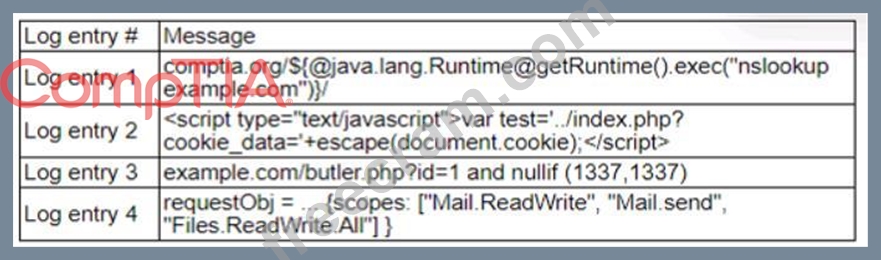
Which of the following log entries provides evidence of the attempted exploit?
- A. Log entry 3
- B. Log entry 2
- C. Log entry 4
- D. Log entry 1
Answer: C
Explanation:
Explanation
Log entry 4 shows an attempt to exploit the zero-day command injection vulnerability by appending a malicious command (;cat /etc/passwd) to the end of a legitimate request (/cgi-bin/index.cgi?name=John). This command would try to read the contents of the /etc/passwd file, which contains user account information, and could lead to further compromise of the system. The other log entries do not show any signs of command injection, as they do not contain any special characters or commands that could alter the intended behavior of the application. Official References:
https://www.imperva.com/learn/application-security/command-injection/
https://www.zerodayinitiative.com/advisories/published/
NEW QUESTION # 41
An older CVE with a vulnerability score of 7.1 was elevated to a score of 9.8 due to a widely available exploit being used to deliver ransomware. Which of the following factors would an analyst most likely communicate as the reason for this escalation?
- A. Asset value
- B. CVSS
- C. Weaponization
- D. Scope
Answer: C
Explanation:
Explanation
Weaponization is a factor that describes how an adversary develops or acquires an exploit or payload that can take advantage of a vulnerability and deliver a malicious effect. Weaponization can increase the severity or impact of a vulnerability, as it makes it easier or more likely for an attacker to exploit it successfully and cause damage or harm. Weaponization can also indicate the level of sophistication or motivation of an attacker, as well as the availability or popularity of an exploit or payload in the cyber threat landscape. In this case, an older CVE with a vulnerability score of 7.1 was elevated to a score of 9.8 due to a widely available exploit being used to deliver ransomware. This indicates that weaponization was the reason for this escalation.
NEW QUESTION # 42
A security analyst discovers the accounting department is hosting an accounts receivable form on a public document service. Anyone with the link can access it. Which of the following threats applies to this situation?
- A. Loss of public/private key management
- B. Cloud-based authentication attack
- C. Potential data loss to external users
- D. Identification and authentication failures
Answer: C
Explanation:
Potential data loss to external users is a threat that applies to this situation, where the accounting department is hosting an accounts receivable form on a public document service. Anyone with the link can access it. Data loss is an event that results in the destruction, corruption, or unauthorized disclosure of sensitive or confidential data. Data loss can occur due to various reasons, such as human error, hardware failure, malware infection, or cyberattack. In this case, hosting an accounts receivable form on a public document service exposes the data to potential data loss to external users who may access it without authorization or maliciously modify or delete it .
NEW QUESTION # 43
A systems administrator is reviewing after-hours traffic flows from data-center servers and sees regular outgoing HTTPS connections from one of the servers to a public IP address. The server should not be making outgoing connections after hours. Looking closer, the administrator sees this traffic pattern around the clock during work hours as well. Which of the following is the most likely explanation?
- A. C2 beaconing activity
- B. Network host IP address scanning
- C. A rogue network device
- D. Data exfiltration
- E. Anomalous activity on unexpected ports
Answer: A
Explanation:
Explanation
The most likely explanation for this traffic pattern is C2 beaconing activity. C2 stands for command and control, which is a phase of the Cyber Kill Chain that involves the adversary attempting to establish communication with a successfully exploited target. C2 beaconing activity is a type of network traffic that indicates a compromised system is sending periodic messages or signals to an attacker's system using various protocols, such as HTTP(S), DNS, ICMP, or UDP. C2 beaconing activity can enable the attacker to remotely control or manipulate the target system or network using various methods, such as malware callbacks, backdoors, botnets, or covert channels.
NEW QUESTION # 44
A risk assessment concludes that the perimeter network has the highest potential for compromise by an attacker, and it is labeled as a critical risk environment. Which of the following is a valid compensating control to reduce the volume of valuable information in the perimeter network that an attacker could gain using active reconnaissance techniques?
- A. A control that demonstrates that the network security policy is reviewed and updated yearly
- B. A control that demonstrates that access to a system is only allowed by using SSH
- C. A control that demonstrates that firewall rules are peer reviewed for accuracy and approved before deployment
- D. A control that demonstrates that all systems authenticate using the approved authentication method
Answer: C
Explanation:
A valid compensating control to reduce the volume of valuable information in the perimeter network that an attacker could gain using active reconnaissance techniques is a control that demonstrates that firewall rules are peer reviewed for accuracy and approved before deployment. This control can help ensure that the firewall rules are configured correctly and securely, and that they do not allow unnecessary or unauthorized access to the perimeter network. The other options are not compensating controls or do not address the risk of active reconnaissance. Reference: CompTIA Cybersecurity Analyst (CySA+) Certification Exam Objectives (CS0-002), page 14; https://www.isaca.org/resources/isaca-journal/issues/2016/volume-3/compensating-controls
NEW QUESTION # 45
Which of the following best describes the document that defines the expectation to network customers that patching will only occur between 2:00 a.m. and 4:00 a.m.?
- A. SLA
- B. MOU
- C. LOI
- D. KPI
Answer: A
Explanation:
Explanation
SLA (Service Level Agreement) is the best term to describe the document that defines the expectation to network customers that patching will only occur between 2:00 a.m. and 4:00 a.m., as it reflects the agreement between a service provider and a customer that specifies the services, quality, availability, and responsibilities that are agreed upon. An SLA is a common type of document that is used in various industries and contexts, such as IT, telecom, cloud computing, or outsourcing. An SLA typically includes metrics and indicators to measure the performance and quality of the service, such as uptime, response time, or resolution time. An SLA also defines the consequences or remedies for any breaches or failures of the service, such as penalties, refunds, or credits. An SLA can help to manage customer expectations, formalize communication, improve productivity, and strengthen relationships. The other terms are not as accurate as SLA, as they describe different types of documents or concepts. LOI (Letter of Intent) is a document that outlines the main terms and conditions of a proposed agreement between two or more parties, before a formal contract is signed. An LOI is usually non-binding and expresses the intention or interest of the parties to enter into a future agreement. An LOI can help to clarify the key points of a deal, facilitate negotiations, or demonstrate commitment. MOU (Memorandum of Understanding) is a document that describes a mutual agreement or cooperation between two or more parties, without creating any legal obligations or commitments. An MOU is usually more formal than an LOI, but less formal than a contract. An MOU can help to establish a common ground, define roles and responsibilities, or outline expectations and goals. KPI (Key Performance Indicator) is a concept that refers to a measurable value that demonstrates how effectively an organization or individual is achieving its key objectives or goals. A KPI is usually quantifiable and specific, such as revenue growth, customer satisfaction, or employee retention. A KPI can help to track progress, evaluate performance, or identify areas for improvement.
NEW QUESTION # 46
After conducting a cybersecurity risk assessment for a new software request, a Chief Information Security Officer (CISO) decided the risk score would be too high. The CISO refused the software request. Which of the following risk management principles did the CISO select?
- A. Mitigate
- B. Transfer
- C. Avoid
- D. Accept
Answer: C
Explanation:
Avoid is a risk management principle that describes the decision or action of not engaging in an activity or accepting a risk that is deemed too high or unacceptable. Avoiding a risk can eliminate the possibility or impact of the risk, as well as the need for any further risk management actions. In this case, the CISO decided the risk score would be too high and refused the software request. This indicates that the CISO selected the avoid principle for risk management.
NEW QUESTION # 47
An employee is suspected of misusing a company-issued laptop. The employee has been suspended pending an investigation by human resources. Which of the following is the best step to preserve evidence?
- A. Make a copy of the files as a backup on the server.
- B. Disable the user's network account and access to web resources
- C. Place a legal hold on the device and the user's network share.
- D. Make a forensic image of the device and create a SRA-I hash.
Answer: D
Explanation:
Explanation
Making a forensic image of the device and creating a SRA-I hash is the best step to preserve evidence, as it creates an exact copy of the device's data and verifies its integrity. A forensic image is a bit-by-bit copy of the device's storage media, which preserves all the information on the device, including deleted or hidden files. A SRA-I hash is a cryptographic value that is calculated from the forensic image, which can be used to prove that the image has not been altered or tampered with. The other options are not as effective as making a forensic image and creating a SRA-I hash, as they may not capture all the relevant data, or they may not provide sufficient verification of the evidence's authenticity. Official References:
https://www.sans.org/blog/forensics-101-acquiring-an-image-with-ftk-imager/
https://swailescomputerforensics.com/digital-forensics-imaging-hash-value/
NEW QUESTION # 48
A SOC analyst recommends adding a layer of defense for all endpoints that will better protect against external threats regardless of the device's operating system. Which of the following best meets this requirement?
- A. CASB
- B. SIEM
- C. EDR
- D. SOAR
Answer: C
Explanation:
Explanation
EDR stands for Endpoint Detection and Response, which is a layer of defense that monitors endpoints for malicious activity and provides automated or manual response capabilities. EDR can protect against external threats regardless of the device's operating system, as it can detect and respond to attacks based on behavioral analysis and threat intelligence. EDR is also one of the tools that CompTIA CySA+ covers in its exam objectives. Official References:
https://www.comptia.org/certifications/cybersecurity-analyst
https://www.comptia.org/blog/the-new-comptia-cybersecurity-analyst-your-questions-answered
https://resources.infosecinstitute.com/certification/cysa-plus-ia-levels/
NEW QUESTION # 49
......
CompTIA CS0-003 Actual Questions and Braindumps: https://www.freecram.com/CompTIA-certification/CS0-003-exam-dumps.html
Pass CS0-003 Exam with Updated CS0-003 Exam Dumps PDF 2023: https://drive.google.com/open?id=1HHl3oi9rtGKp999csBKPvux0yT26Z-sA