

100% Updated Cisco 300-620 Enterprise PDF Dumps
Use Valid Exam 300-620 by FreeCram Books For Free Website
NEW QUESTION # 169
Which role do interfaces Ethernet 1/49-50 have in this output?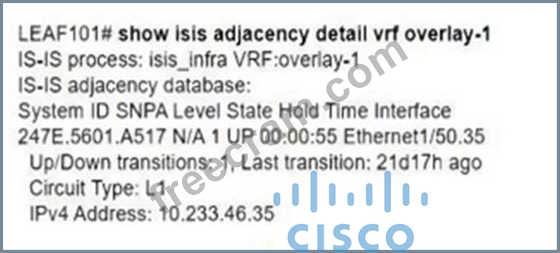
- A. leaf fabric ports
- B. server fabric ports
- C. server uplink ports
- D. leaf access ports
Answer: A
NEW QUESTION # 170
Refer to the exhibit. Cisco ACI fabric is connected to a Cisco Catalyst 3850 Series Switch using EBGP. Server 2 is unable to communicate with Server 1. Leaf-2 fails to learn the external subnet
10.2.2.0/24 and other external subnets from other L3Outs. Which configuration ensures that the networks from Leaf-2 are learned by the external network?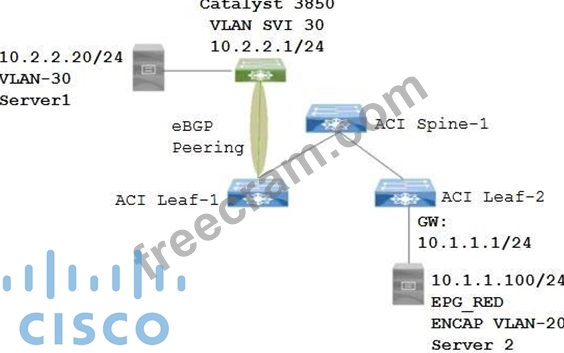
- A. Implement a contract between the Server 2 EPG and the L3Out.
- B. Configure Spine-1 as the MP-BGP route reflector.
- C. Configure 10.2.2.0/24 under the external EPG of the L3Out.
- D. Implement the bridge domain to advertise the bridge domain subnet.
Answer: B
NEW QUESTION # 171
Which two dynamic routing protocols are supported when using Cisco ACI to connect to an external Layer 3 network? (Choose two.)
- A. IS-IS
- B. VXLAN
- C. RIPv2
- D. iBGP
- E. eBGP
Answer: D,E
Explanation:
https://www.cisco.com/c/en/us/td/docs/switches/datacenter/aci/apic/sw/1- x/ACI_Best_Practices/b_ACI_Best_Practices/ b_ACI_Best_Practices_chapter_010010.html
NEW QUESTION # 172
Which endpoint learning operation is completed on the ingress leaf switch when traffic is received from a Layer 3 Out?
- A. The source MAC address of the traffic is learned as a remote endpoint.
- B. The source MAC address of the traffic is learned as a local endpoint.
- C. The source IP address of the traffic is learned as a local endpoint.
- D. The source IP address of the traffic is learned as a remote endpoint.
Answer: B
Explanation:
https://www.cisco.com/c/en/us/solutions/collateral/data-center-virtualization/application-centric- infrastructure/white-paper-c11-739989.pdf Refer to Table 6 which says, Local endpoint learning with an incoming packet from L3Out to Cisco ACI:
Only the source MAC address is learned as a local endpoint.
The source IP address is not learned as a local endpoint.
NEW QUESTION # 173
A company is running a multi-pod environment across two data centers and wants to expand to co-locations. Which solution extends the application centric infrastructure (ACI) policy with minimum investment?
- A. dedicated equipment to extend the existing multi-pod
- B. dedicated equipment for a new site in a multi-site deployment
- C. new leaf switches to be used in a remote-leaf architecture
- D. dedicated equipment for a dedicated ACI fabric
Answer: C
Explanation:
A remote-leaf deployment lets you hang a small set of ACI leaf switches at a co-location and extend your existing pods' policy and connectivity without deploying a full fabric or separate site.
It requires only the new remote leaves and WAN connectivity back to your spines, minimizing both hardware and configuration overhead.
NEW QUESTION # 174
Which endpoint learning operation is completed on the ingress leaf switch when traffic is received from a Layer 3 Out?
- A. The source MAC address of the traffic is learned as a remote endpoint.
- B. The source MAC address of the traffic is learned as a local endpoint.
- C. The source IP address of the traffic is learned as a local endpoint.
- D. The source IP address of the traffic is learned as a remote endpoint.
Answer: B
NEW QUESTION # 175
How is an EPG extended outside of the ACI fabric?
- A. Create an external bridged network that is assigned to a leaf port.
- B. Enable unicast routing within an EPG.
- C. Statically assign a VLAN ID to a leaf port in an EPG.
- D. Create an external routed network that is assigned to an EPG.
Answer: C
Explanation:
An EPG is extended outside of the ACI fabric by statically assigning a VLAN ID to a leaf port in an EPG. This method maps the traffic received on the leaf port to the EPG, and the policy for this EPG is enforced
NEW QUESTION # 176
Where is the COOP database located?
- A. endpoint
- B. spine
- C. APIC
- D. leaf
Answer: B
NEW QUESTION # 177
An engineer configures a Cisco ACI Multi-Pod for disaster recovery. Which action should be taken for the new nodes to be discoverable by the existing Cisco APICs?
- A. Enable DHCP relay on all links that are connected to Cisco ACI spines on IPN devices.
- B. Configure IGMPv3 on the interfaces of IPN routers that face the Cisco ACI spine.
- C. Enable subinterfaces with dot1q tagging on all links between the IPN routers.
- D. Configure BGP as the underlay protocol in IPN.
Answer: A
Explanation:
For the new nodes in a Cisco ACI Multi-Pod deployment to be discoverable by the existing Cisco APICs, DHCP relay should be enabled on all links that are connected to Cisco ACI spines on Inter-Pod Network (IPN) devices. This allows the APICs to dynamically assign IP addresses to the new nodes, facilitating their discovery and integration into the fabric.
Reference:
Cisco ACI Multi-Pod Configuration Guide
Cisco ACI Best Practices Guide
NEW QUESTION # 178
Drag and drop the Cisco ACI Layer 4 to Layer 7 service insertion terms on the left to the correct descriptions on the right.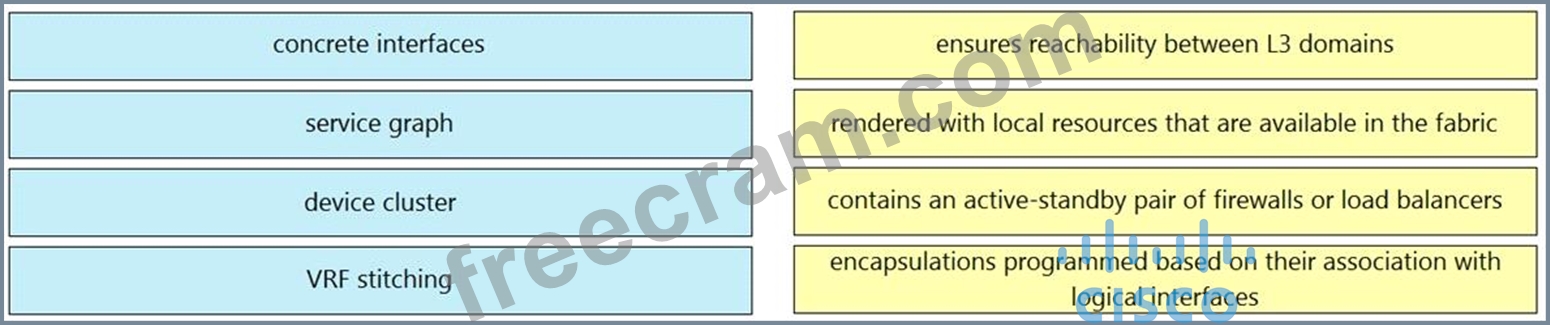
Answer:
Explanation: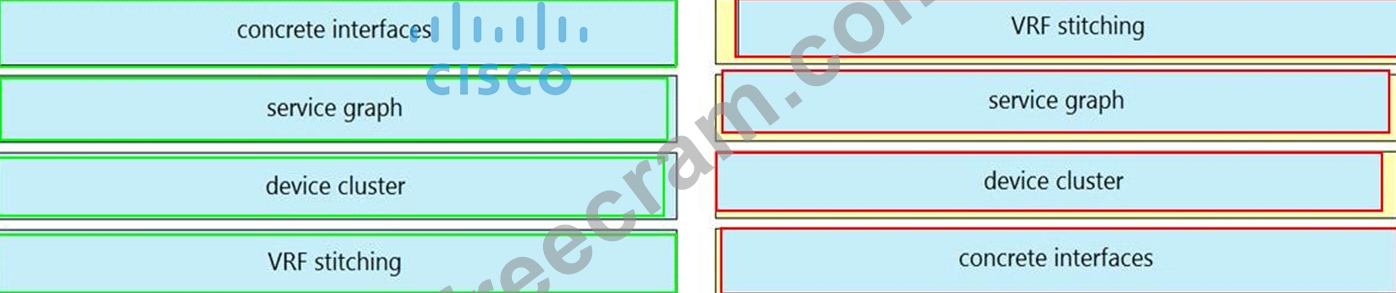
NEW QUESTION # 179
How does Cisco ACI detect the IP address of a silent host that moved from one location to another without notifying a Cisco ACI leaf?
- A. Endpoint announce messages are sent to COOP.
- B. ARP requests are flooded in the bridge domain.
- C. Silent hosts are detected by the ACI fabric.
- D. Bounce entries are installed on the leaf switch.
Answer: B
Explanation:
In a Cisco ACI fabric, when a silent host moves from one location to another without notifying the ACI leaf switch (e.g., via Gratuitous ARP), the detection mechanism depends on how the bridge domain is configured. Specifically, ARP flooding can help detect such silent hosts.
NEW QUESTION # 180
A customer must deploy three Cisco ACI based data centers. Each site must be separated from the others. Which characteristic of Cisco ACI Multi-Pod makes it unsuitable for this deployment?
- A. places leaf switches in the remote site that belong to the same fabric as at the headquarters site
- B. requires all pods to share the same Cisco APIC cluster
- C. creates a virtual pod in the remote location
- D. has distance and scale limitations
Answer: B
NEW QUESTION # 181
A network engineer is integrating a new Hyperflex storage duster into an existing Cisco ACI fabric The Hyperflex cluster must be managed by vCenter so a new vSphere Distributed switch must be created In addition the hardware discovery must be performed by a vendor-neutral discovery protocol Which set of steps meets these requirements'?
- A. Option D
- B. Option A
- C. Option C
- D. Option B
Answer: D
Explanation:
To integrate a new Hyperflex storage cluster into an existing Cisco ACI fabric and manage it with vCenter, the following steps should be taken:
Create a new vSphere Distributed Switch (vDS): This is done within the vCenter interface. The vDS acts as a single virtual switch across all associated hosts in the data center, providing centralized management and monitoring of the network configuration1.
Configure the vDS for the Hyperflex cluster: This involves setting up the correct port groups, VLANs, and uplink profiles to ensure proper network segmentation and performance2.
Enable hardware discovery using a vendor-neutral protocol: This could involve using protocols like LLDP (Link Layer Discovery Protocol) or CDP (Cisco Discovery Protocol), which are supported by vCenter and can help in identifying and managing physical network devices3.
Integrate the Hyperflex cluster with ACI using the Application Policy Infrastructure Controller (APIC): This involves creating the necessary policies and profiles in ACI to manage the Hyperflex storage traffic effectively4.
Reference:
Cisco HyperFlex Systems Installation Guide for VMware ESXi1
Cisco HyperFlex Virtual Server Infrastructure 3.0 with Cisco ACI 3.2 and VMware vSphere 6.52 How to Set Up Networking with vSphere Distributed Switches - VMware Docs3 Tutorial: How to integrate HyperFlex and ACI with VMM (VMware) and UCSM4
NEW QUESTION # 182
A customer migrates a legacy environment to Cisco ACI. A Layer 2 trunk is configured to interconnect the two environments. The customer also builds ACI fabric in an application-centric mode. Which feature should be enabled in the bridge domain to reduce instability during the migration?
- A. Disable Endpoint Dataplane Learning
- B. Set Multi-Destination Flooding to Flood in Encapsulation.
- C. Enable Flood in Encapsulation.
- D. Set Multi-Destination Flooding to Flood in BD.
Answer: C
NEW QUESTION # 183
An engineer is configuring a new user account in Cisco ACI. The new user will be assigned the role of fabric administrator. The fabric has only one tenant, so the engineer associated the new user account with a security domain for the tenant, as well as the security domain for the management tenant. Which configuration permits the new user with admin access to the fabric?
- A. Associate the new user with the security domain all.
- B. Grant the new user R/W access to the user and management tenant.
- C. Bind the security domain infra to the new user account.
- D. Add the DN uni/fabric under explicit rules.
Answer: C
Explanation:
Access Rights Workflow Dependencies
The Cisco Application Centric Infrastructure (ACI) RBAC rules enable or restrict access to some or all of the fabric. For example, in order to configure a leaf switch for bare metal server access, the logged in administrator must have rights to the infra domain. By default, a tenant administrator does not have rights to the infra domain. In this case, a tenant administrator who plans to use a bare metal server connected to a leaf switch could not complete all the necessary steps to do so.
The tenant administrator would have to coordinate with a fabric administrator who has rights to the infra domain. The fabric administrator would set up the switch configuration policies that the tenant administrator would use to deploy an application policy that uses the bare metal server attached to an ACI leaf switch.
https://www.cisco.com/c/en/us/td/docs/switches/datacenter/aci/apic/sw/5-x/security/cisco-apic- security-configuration-guide-50x/m_access_authentication_and_accounting.html
NEW QUESTION # 184
Which two protocols are used for fabric discovery in ACI? (Choose two.)
- A. DHCP
- B. OSPF
- C. LLDP
- D. ISIS
- E. CDP
Answer: A,C
NEW QUESTION # 185
An engineer is implementing a connection that represents an external bridged network. Which two configurations are used? (Choose two.)
- A. Layers 2 internal
- B. Static path binding
- C. VXLAN outside
- D. Layer 2 outside
- E. Layer 2 remote fabric
Answer: D,E
NEW QUESTION # 186
Which two actions extend a Layer 2 domain beyond the ACI fabric? (Choose two.)
- A. extending the routed domain out of the ACI fabric
- B. extending the bridge domain out of the ACI fabric
- C. extending the EPG out of the ACI fabric
- D. creating a single homed Layer 3 Out
- E. creating an external physical network
Answer: B,C
Explanation:
There are several different ways to extend layer 2 domain beyond the ACI fabric:
● Extend the EPG out of the ACI fabric - A user can extend an EPG out of the ACI fabric by statically assigning a port (along with VLAN ID) to an EPG. The leaf will learn the endpoint information and assign the traffic (by matching the port and VLAN ID) to the proper EPG, and then enforce the policy. The endpoint learning, data forwarding, and policy enforcement remain the same whether the endpoint is directly attached to the leaf port or if it is behind a layer 2 network (provided the proper VLAN is enabled in the layer2 network).
● Extend the bridge domain out of the ACI fabric - Another option to extend the layer 2 domain is to create a layer 2 outside connection (or external bridged network, as called in the APIC GUI) for a given bridge domain. It effectively extends the bridge domain to the outside network.
https://www.cisco.com/c/en/us/solutions/collateral/data-center-virtualization/application-centric- infrastructure/white-paper-c07-732033.html#_Toc395143568
NEW QUESTION # 187
......
Cisco 300-620 Official Cert Guide PDF: https://www.freecram.com/Cisco-certification/300-620-exam-dumps.html
Free CCNP Data Center 300-620 Official Cert Guide PDF Download: https://drive.google.com/open?id=1NoKOgTaMbO7yYfQioPiQ0D-JHznywPI4